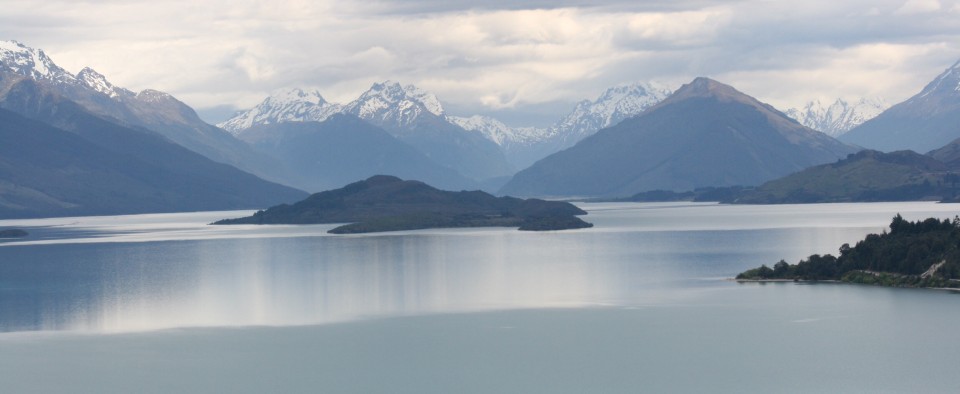
June 24th – Today was a light travel day as we were at sea the whole day, sailing from Germany to Lithuania. After breakfast we spent a quiet morning reading and dozing. The afternoon was much busier with two lectures and a cooking class.
The first lecture was a brief background to the Baltic States by Prof. Kathleen Wulf, a retired professor from USC. She did a great job in 45 minutes covering each of the three countries we will be visiting in this area.
The second lecture was about the history of Carl Faberge – jeweller to the Tsar and many other famous characters. It was interesting to hear about many of the famous eggs and sad to learn that there is only a minimal involvement in the company by distant relatives. In fact, the Faberge name was licensed many years ago and its value has been basically lost.
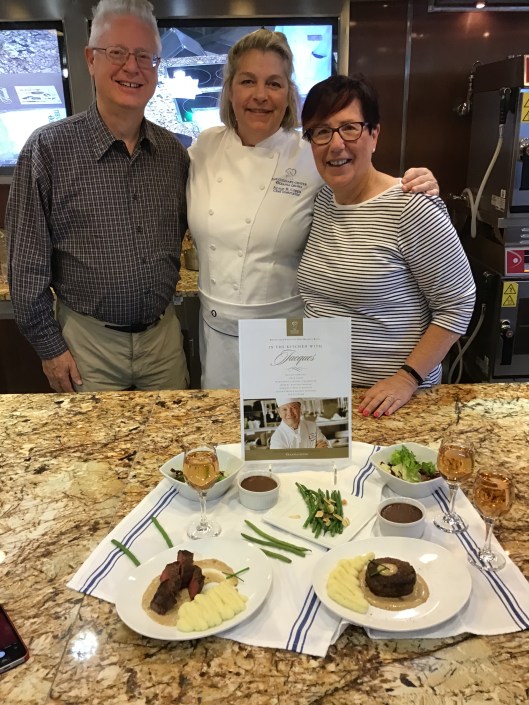
The excitement of the day was a cooking class in the cuisine centre. What fun! We learned how to make a creamy vinaigrette dressing, cook green beans so they taste like they’re fresh off the vine, make steak Diane, creamy mashed potatoes, and a chocolate pot de creme. It all tasted wonderful…if one could ignore the quantity of butter and 35% cream used along the way.
We could easily have been satisfied with a bowl of soup for supper, but we had been invited to join the Smiths for Ruth’s birthday celebration. Another meal and cake with ice cream – we just waddled back to our room. Conversation over dinner was interesting and varied. Joining the foursome was Max, an architect from the US who had worked in Iran during the downfall of the Shah. He told some really interesting stories. It has been a challenge trying to engage with Americans without discussing the current political situation. We work diligently not to use the ‘T’ word.
June 25th – we arrived in the port of Klaipeda, Lithuania, about 7 a.m. after a rather noisy few hours. It was quite windy out and we think the wind was bouncing off our veranda divider causing a whining noise. It started about 3:30 a.m. and continued until we entered the channel into port. We were able to sleep a bit but we were both quite restless. It had to be loud for it to awaken George!
Lithuania is the largest of the Baltic countries that we will be visiting. It covers 25,200 square miles and has a population of 2.7 million. The capital is Vilnius but that is too far inland for us to visit. Klaipeda is considered to be the Baltic’s finest port.
Our tour today was to the seaside town of Palanga, where we visited the (Catholic) Church of St Mary and the palace of Count and Countess Tyszkiewicz. The family were very wealthy and used their wealth to develop the town. The church built by the Countess is, once again, made of brick since there is no natural stone in the area. It was finished around 1923. Deconsecrated during the Russian occupation it was used as a music school. Following independence it once again became a church but church leaders had to bring in altars and other religious necessities from churches in France since the originals had all been destroyed.

St Mary’s Klaipeda
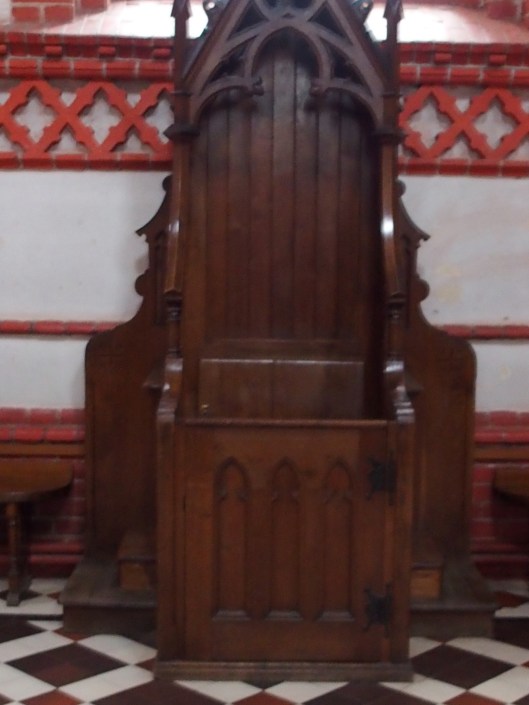
Open confessional – no privacy here
The palace is set in an idyllic botanical garden with a long footpath between the road and the house. The gardens include two man-made ponds, annual gardens and rose gardens. Behind the palace is a short walk to the sea. All of the trees in the surrounding forested area were planned and planted intentionally. The family is thought to have fled to the United States through Germany to avoid the Russians but they have completely disappeared despite an extensive search by researchers.
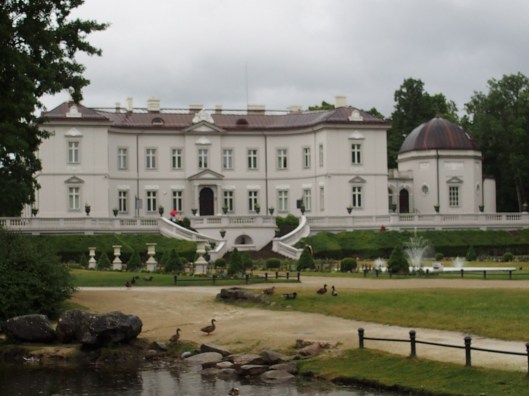
Amber Museum
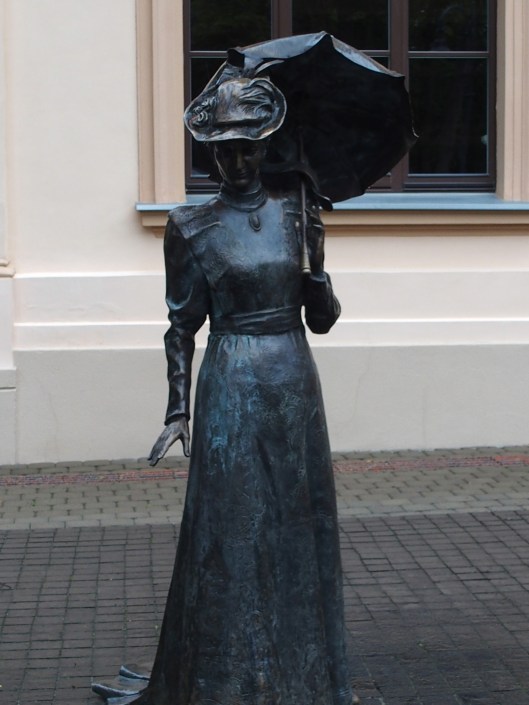
The Countess
The main floor has been reconstructed as living quarters with period furniture sourced from the area. The second floor houses the Palanga Amber Museum where one can see how amber develops and view many different kinds of amber. Unfortunately time didn’t permit an in-depth visit.
Our next stop was the old town of Klaipeda where we got to taste Lithuanian beer and take a brief walking tour ending up at an amber showroom. From there we returned to the ship on foot.
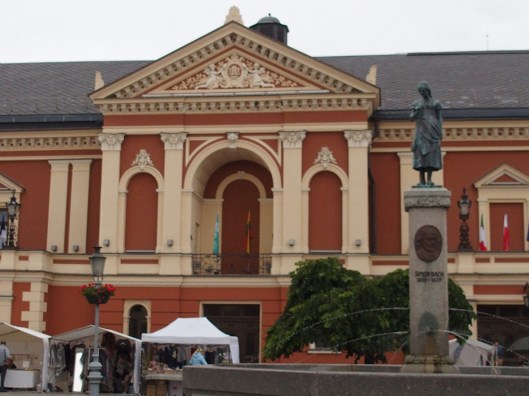
Theatre Square with monument dedicated to Simon Dach, a German poet born in Klaipeda
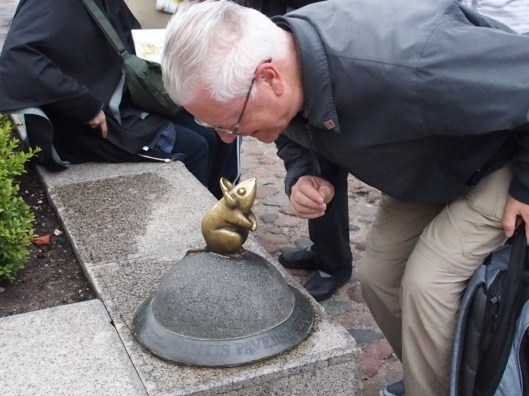
Kiss the mouse and make a wish
After lunch and a brief rest we attended another lecture by Prof. Wulf – this time about Russia. Part one took us up to the end of WWI. Tomorrow she will continue through to present day. Dinner tonight was at the Polo Grill – a steakhouse.
 nancybellblog