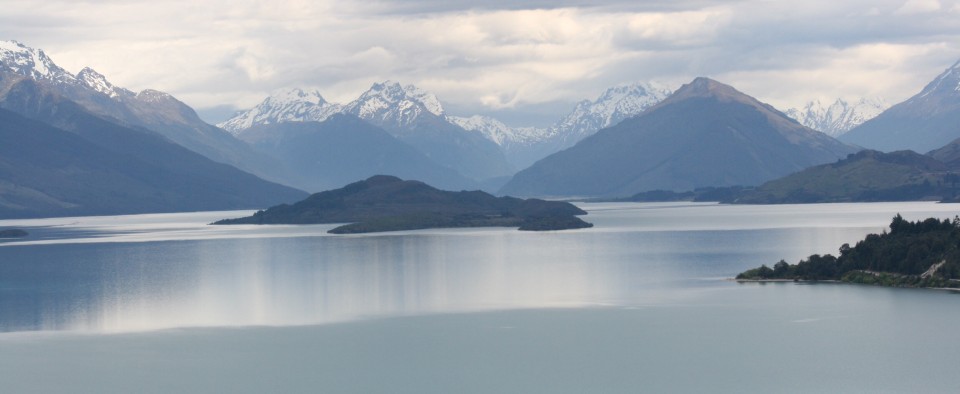
After returning from a visit to a friend in Malawi, Africa, our son expressed an interest in returning with his dad to see the places where George taught in the 1970s with CUSO. This blog is the story of their trip. It’s taken a few months to get this up on the blog…but such is the busy life we lead.
March 4-5 – George and I arrived at Pearson a little after 7am for our flight which was scheduled to depart around 10am. It seemed slightly strange to be taking an overseas trip that left in the morning. We’re more used to the evening departure.
Our first decision was what to do with our walking sticks since we weren’t sure we would be able to get them through security. Fortunately, we were able to wedge them diagonally into my checked luggage.
My last purchase on Canadian soil was 10 bottles of maple syrup – mementos of Canada for our overseas friends. We had tried to purchase them prior to arriving at the airport but weren’t able to find the little bottles. Must remember to pick some up at the Mennonite farm in St Jacobs next time we go. Price will be significantly less.
Our flight was on Ethiopian Airlines, starting in Toronto and ending in Johannesburg with a layover in Addis Ababa. The first segment was full with people of all races and garb on board. I ended up chatting with a white woman originally from Nelspruit, South Africa. Her husband, one of her daughters, and she had emigrated to Saskatoon about 15 months earlier. But the pull of extended family was just too strong – they were returning to South Africa.
After a few hours in the Addis airport, we continued on with the second segment. This flight was not nearly as full. I remember one unusual practice – a spraying of the overhead luggage shortly after take-off – not sure what that was all about.
When we arrived in Johannesburg, early afternoon, George got our two phones set up for use in South Africa. Next, he expedited the car rental process and avoided a long lineup by taking advantage of his Avis Preferred status. We had a Toyota Corolla for the next 12 days. Meanwhile, I got 2,000 Rand out of the bank. It was just enough to last us to the end of our stay in South Africa.
We drove up to Pretoria and found our Holiday Inn Express in the Sunnypark area. The parking was six storeys up, and coincided with the level of the hotel reception area. We discovered later that this level also opened through a secure entrance to a level in the Sunnypark Shopping Centre, a quite nice mall.
We decided to go out to the neighbourhood for supper and a short walkabout. Our first meal was at McDonald’s. The neighbourhood was a bit rough. Although the sidewalks had been prettified, they had deteriorated significantly. Everyone we encountered on the street was black, but we didn’t have the sense that we were unwelcome in the area. Just before sundown, we returned to our room and bedded down for the night.
March 6 – Today was our first full day in Africa. On our exit from Pretoria, we managed to make a wrong turn, and spent about 45 minutes making up for it. African taxis are a very important means of travel, especially for workers. We saw that over and over again in every country we visited. They also are driven by brazen drivers.
We enjoyed our drive through the Western Transvaal on our way to Botswana. We saw some circular farms – marked by irrigation systems fed by a central well. As time went by, the scenery became hillier and drier.

Art show by the roadside
People serving at land border outposts are a special breed. Life moves slowly there. Eventually, we made it through Martin’s Drift. As we crossed into Botswana, we noticed the rushing waters of the Limpopo. This area of Botswana has had a good rainy season.
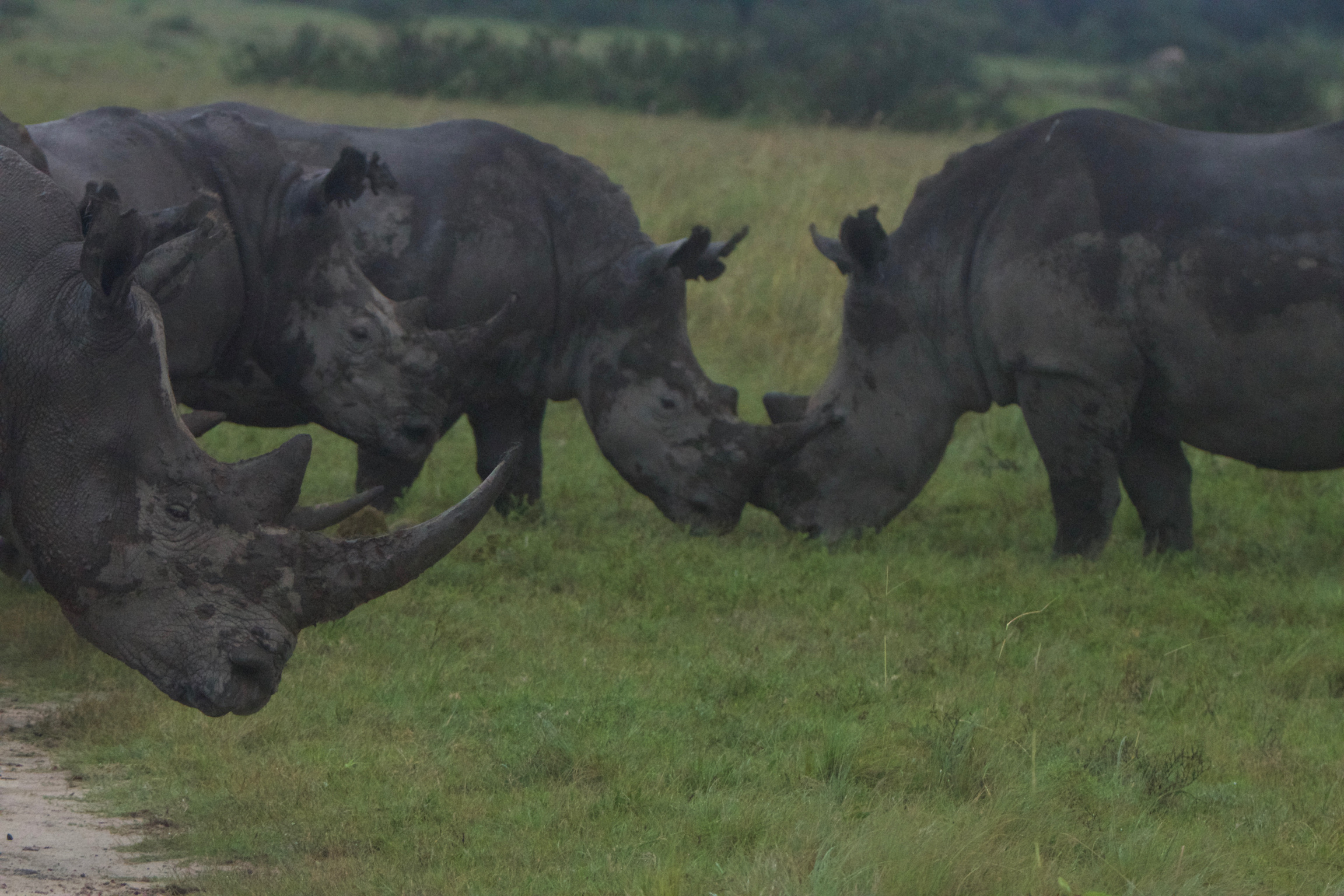
We drove through Palapye and Serowe to the Khama Rhino Camp. Just after climbing aboard our tour vehicle (we were the only clients this afternoon), the sky parted and we were completely soaked. Despite the rain, we got up close and personal with a group of rhinos, checking out their interactions for about half an hour. Interestingly, members of the Botswana military were at the Rhino Camp, deterring poachers.
We made it back to the Majestic Five Hotel in Palapye a little later than planned, but we were able to put ourselves together in time to greet two of my former Moeng students, Leka and Golekanye. After an hour or so chatting in the hotel lobby, vainly waiting for a third student, we retired to the dining room and enjoyed a lovely buffet. Leka described how she became a dietitian; her original intention was to become a doctor, but her cohort of students was steered into different professions. Though she is now divorced, she also shared experiences as the wife of a diplomat, and as the mother of three boys. Golekanye worked at power plants, and is now late in his career at a local mill.
It was a remarkable evening, catching up on over 40 years of life.
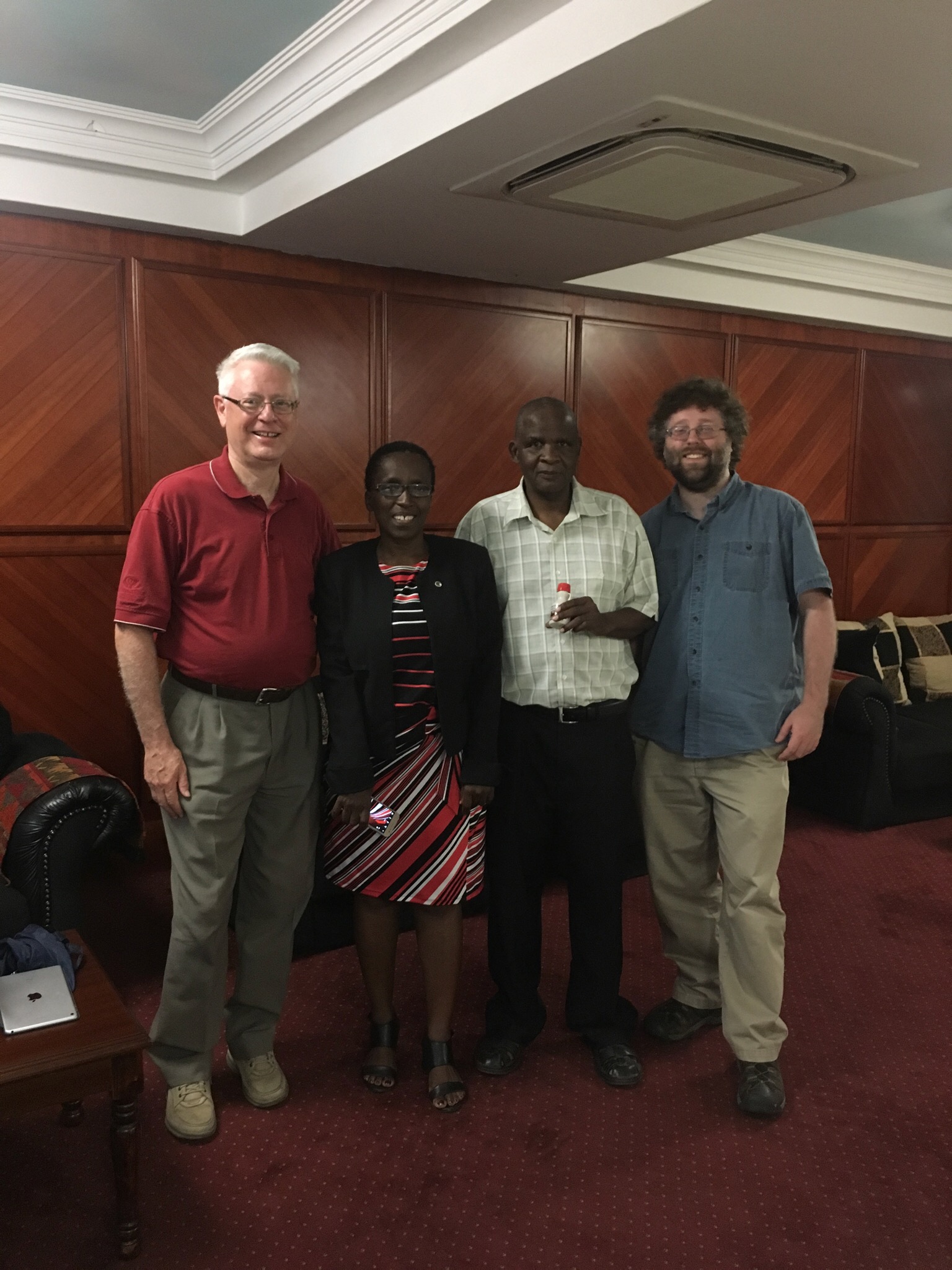
Two former Moeng students
March 7 – The next day was no less full. We retraced some of yesterday’s travel on our way to Moeng College, where I taught for 14 months in 1972-73.

New entrance to Moeng College courtesy of Jim Jagow
Unlike when I was there last, the road to Moeng is completely paved. There is a gate at the perimeter of the school. My first impression was that the school was much bigger than I remembered it – there were lots of new buildings – a real maze.
We were directed to School Head’s office. Abram Thapedi is a serious school administrator who has been at the school for about four years. His office is in the same location as when I was there. Moeng College now has about 1300 Form Four and Form Five students. There are 34 classes and 29 different subjects being taught. All of the teachers are from Botswana. Because of a problem in one of the boys’ dormitories, the number of girls is slightly larger.
As we walked about the school buildings, there were memories of bygone days – Form 1C, the Staff Room, the house that was home for 14 months, the dining hall, the tennis courts. Not everything has survived – the farm and garden, and store have made way for new buildings.
Since last year’s results were in the process of being reviewed by the staff, Mr. Thapedi described his way of measuring the quality of his staff’s work. Prior to his arrival, the former school head had been on study leave, and an interim head had not been selected. Needless to say, the students’ results suffered. During the last four years, the quality of students in the intake has dramatically worsened. In the most recent year, there were no incoming students with an A average. I seem to recall that the school’s results had also worsened, but not as badly, such that there actually was a growing improvement in the Form Five results relative to the incoming Form Three results.
Mr. Thapedi introduced us to Flora, the maid at the School Head’s house where three of the staff now reside. He needs a smaller residence since his wife and family do not reside at the school. Flora told us that Minnie, my maid from 1973, has retired and is living in Ratholo. I asked her to let Minnie know that I was asking for her.
As we walked by my old house, he shared the nickname for the neighbourhood – the Snake Park. That brought back memories of a late night encounter with a snake on the door step many years ago.
We appreciated Mr. Thapedi’s warm welcome and his generosity in arranging the tour for us.
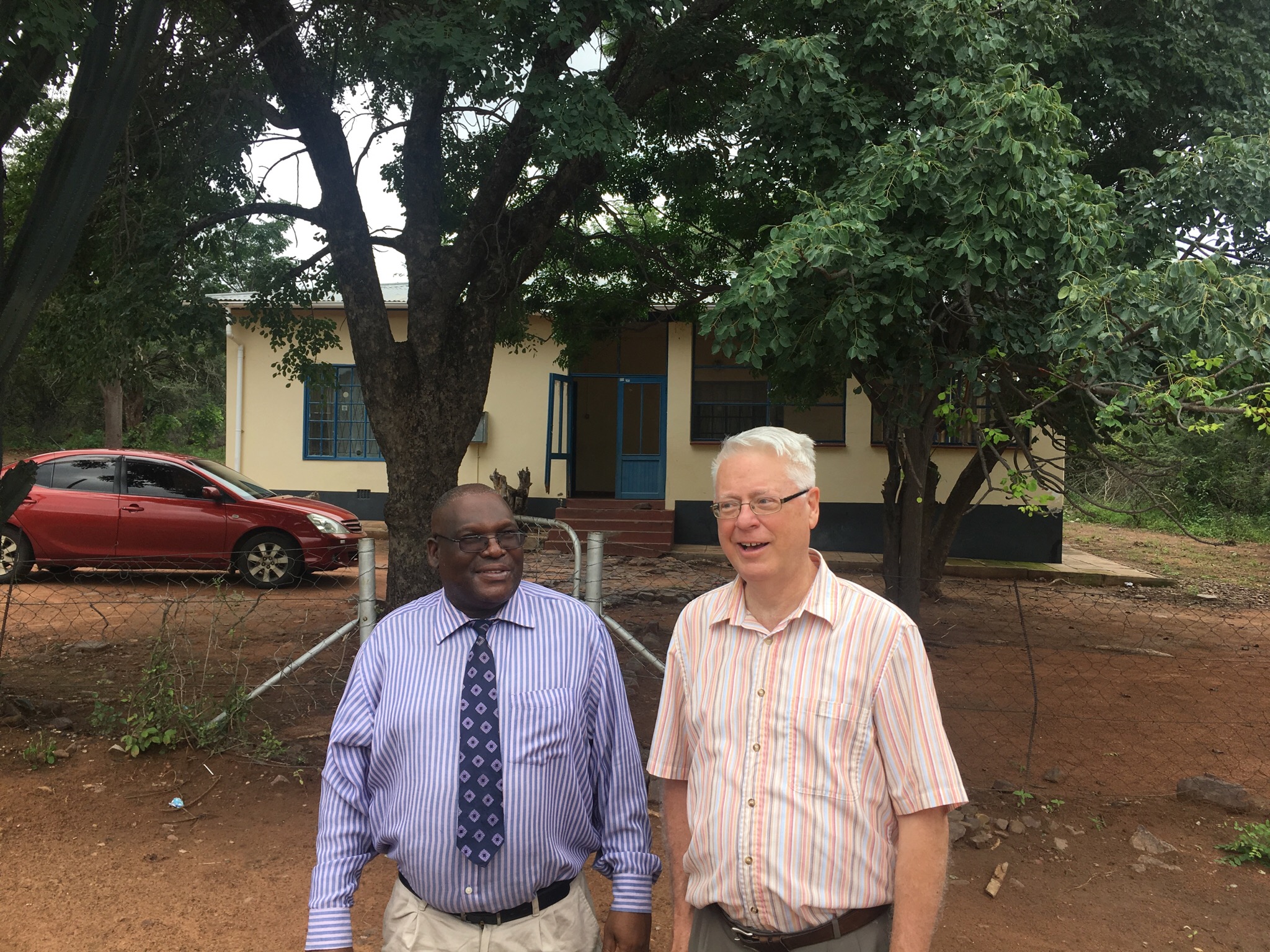
My old house
Our next stop was Gaborone. We stayed at the Cresta President Hotel overlooking the Main Mall. There we met two other former Moeng students. Because we had not bought a Sim card for the I-Phone, we ended up communicating by email. Eventually, we found each other for a meal at Cappuccino’s Airport Junction Mall.
Ben has had a varied career as a geologist and consultant since we last met in Toronto in the early 1980’s. Because of the nature of the geologist’s life, he lost our contact information. He was really glad to make contact again. Joe was the Director of Botswana Game and Wildlife, but has now taken on a Security role at the Jwaneng Diamond Mine. We had a wide-ranging conversation over dinner. Again, a third student who was a possible attendee didn’t make it due to a death in the family.

In the process of arranging these two get-togethers, I discovered that another former student, Tuduetso, is Joe’s aunt. She and I will communicate by email once I return to Canada.
March 8 – This day is a long day, too, for we are planning to drive from Gaborone to Ladysmith in Natal Province. We were off early. The border crossing at Tlokweng Gate is probably the busiest one between Botswana and South Africa. Even so, we weren’t delayed very long.
Our big event for the day was a tour of the Cradle of Humankind World Heritage Site at Maropeng. Maropeng means “returning to the place of origin” in Setswana, the main indigenous language in this area of South Africa. A UNESCO World Heritage Site covering some 47,000 acres, the science centre-like display focuses on humankind and how we developed with a special focus on the African connection.
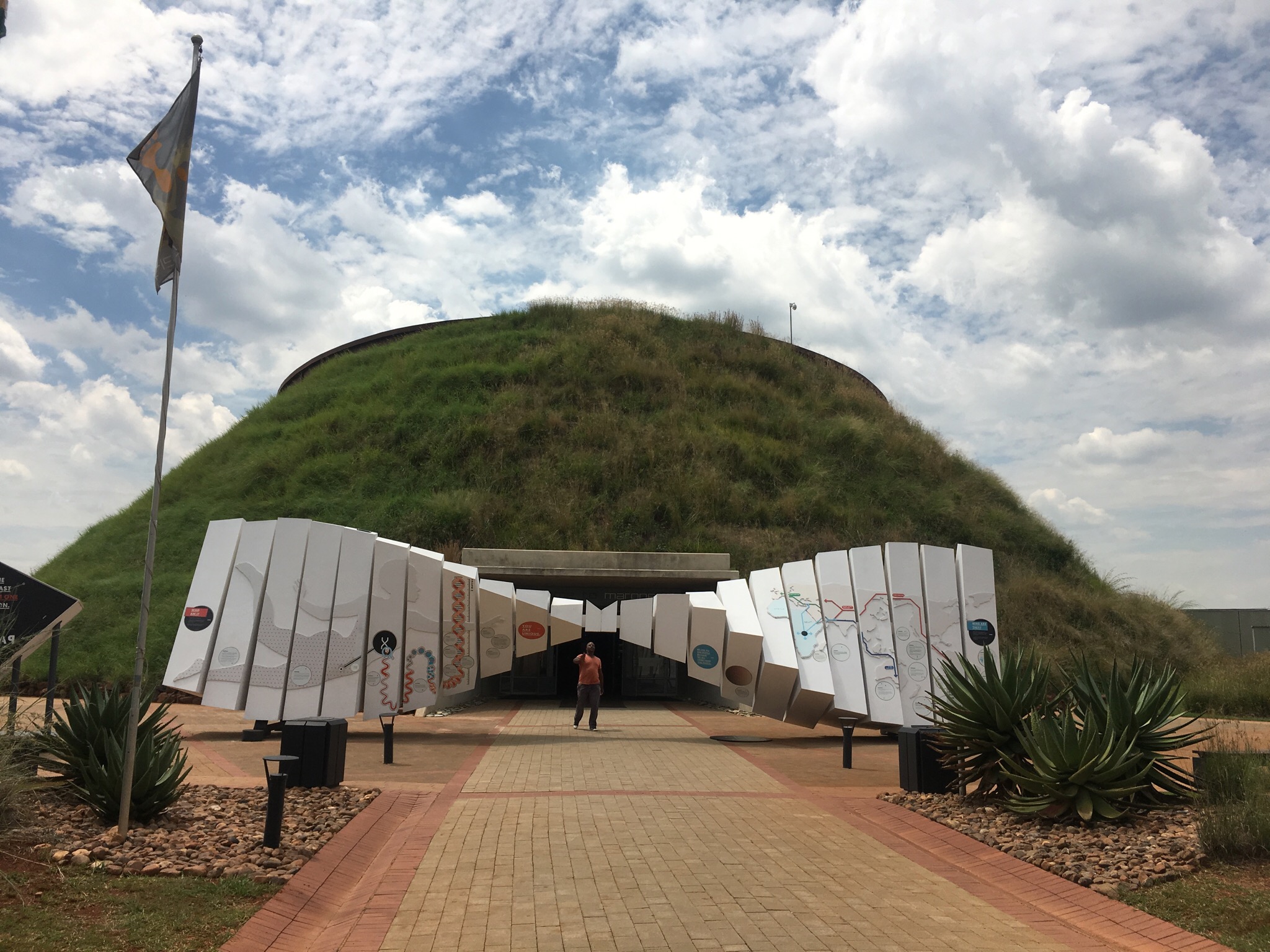
Entrance to Cradle of Humankind World Heritage Sight
Also on the site are the Sterkfontein Caves home to the oldest and most continuous paleaontological dig in the world and home to finds that date back millions of years. We were fortunate that our tour group was a fraction of the size of the group before us.

Sterkfontein Caves
Driving around Johannesburg at rush hour was a tad exciting because of our unfamiliarity with the highways, but we didn’t make any miscues. Even so, we didn’t arrive at the Royal Hotel in Ladysmith until well after dark.
One wrinkle that we haven’t seen in Canada is the practice of the police to nab speeders who drive between two spots in the road in a time period shorter than the time period needed to travel that distance at the speed limit.
March 9-10 – Today we set off bright and early for the Royal Natal National Park which forms part of the Drakensberg Park World Heritage Site. The main features of the park are the Drakensberg Amphitheatre, a rock wall 5 kilometres (3.1 mi) long by up to 1,200 metres (3,900 ft) high, Mon-Aux-Sources peak where the Orange and Tugela rivers have their source, and the 948-metre (3,110 ft) Tugela Falls, the world’s second-highest waterfall. We enjoyed a slightly strenuous walk through the park, eventually sighting the Ampitheatre in the distance. On our return journey, we passed about 20 people going in the opposite direction.
After stopping for a tour with a local guide to see rock art, we headed back to the car. About two minutes before we arrived back at the parking lot, the deluge began. One can only guess how the other walkers on the Ampitheatre route fared.
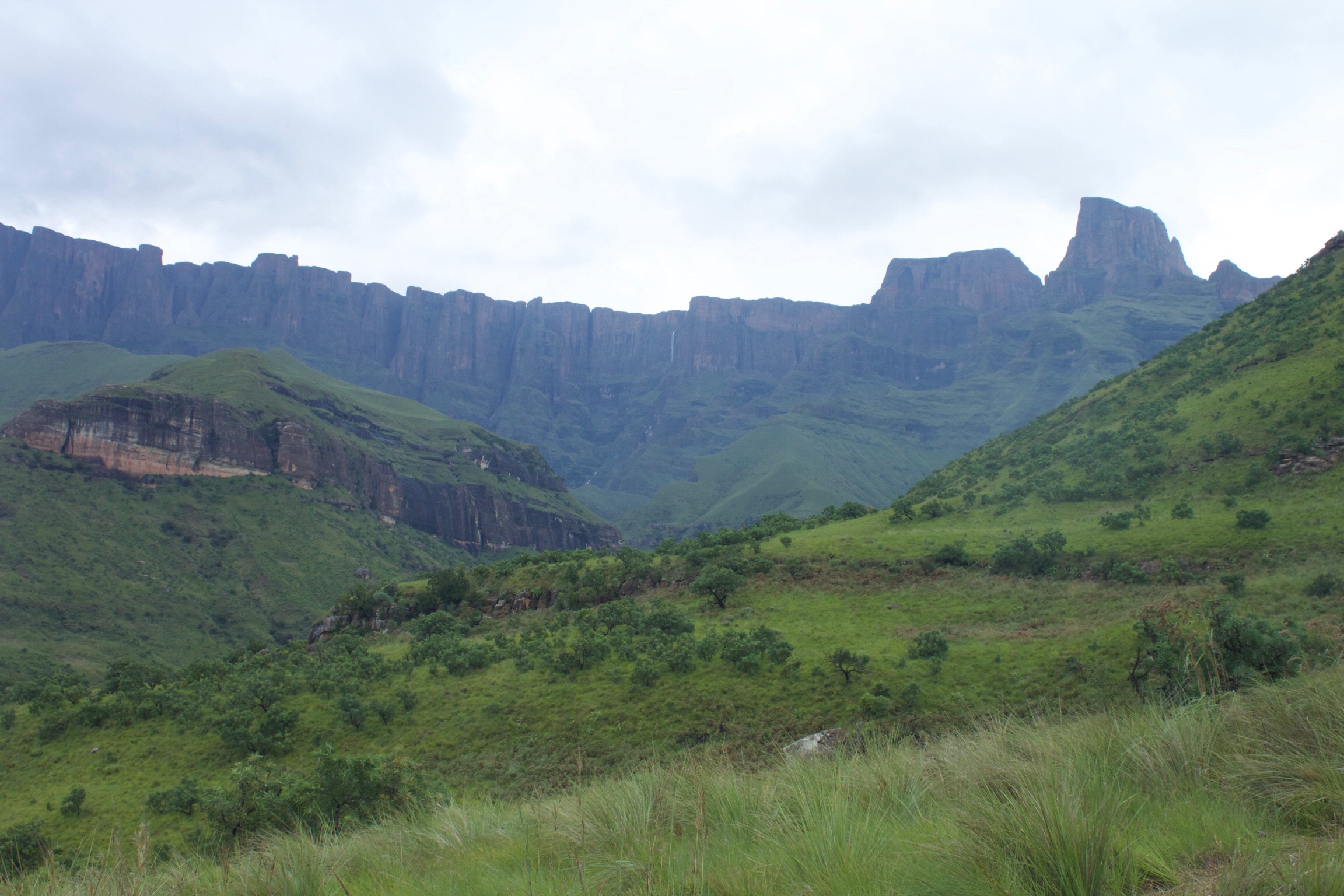
Drakensberg Amphitheatre
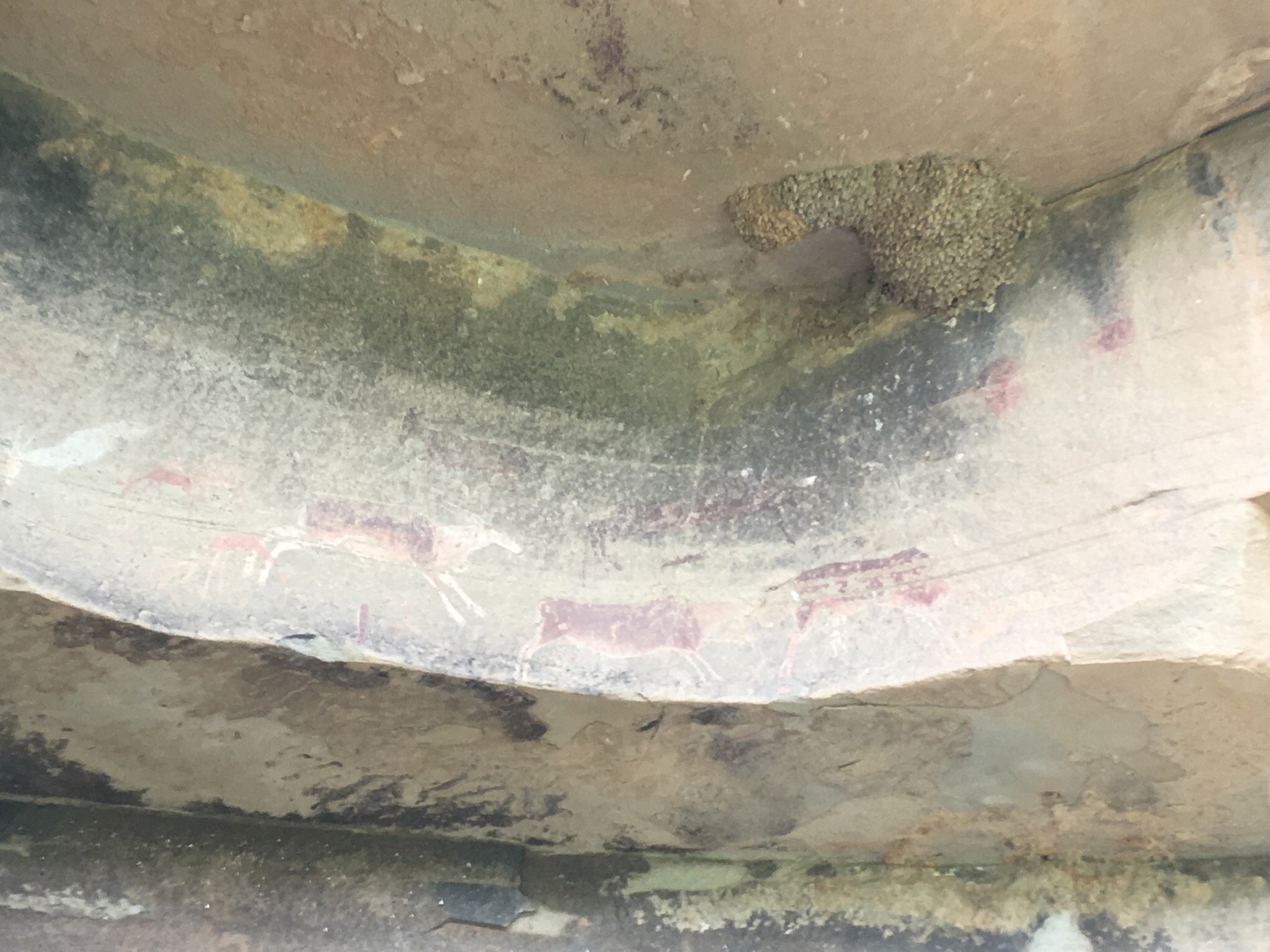
Rock Art
Of course, our excitement wasn’t over. We still had to drive over roads that are prone to washouts when a torrential downpour occurs. Eventually we drove out of the worst of the storm, but we had a few exciting moments.
As we drove on to Durban, we continued to experience inclement weather. Finally, we arrived at the home of Brian and Linda Downie, two members of the extended family on my mother’s side through marriage. Brian is a cousin of my cousin, Paul Downie. Paul and I are related through our mothers being sisters. Brian and Paul are cousins through fathers being brothers. Brian and Linda have travelled to Canada, and met various Downie cousins. They told stories and shared pictures of their visit to southern Ontario. At least one relative from the Canadian Downie clan has visited them – Maureen and Vince Brown.
We showed them the Hunter family website and how the Downies and Bells appear there. They were quite interested in the pictures from Aunt Kathleen’s Celebration of Life event at the Old Mill. They were saddened to learn of recent deaths in the Downie family, cousins Shelagh and Edgar. We spent time describing recent news about Gord Downie’s health and The Tragically Hip’s national tour, and Gord’s involvement in The Secret Path initiative.
Brian and Linda live in Mount Edgecombe Country Club, about 20 km north of Durban. They have lived in the Durban area since arriving in South Africa over 40 years ago. They moved to Mt. Edgecombe after their two girls moved out, one to Auckland, and the other to Johannesburg. It is a beautiful home which backs out onto a pond populated by water birds.
We enjoyed a home cooked meal with them on Thursday night and a trip to the boardwalk in downtown Durban on Friday. George and Brian went for a one-hour bike ride, while Linda and I walked the boardwalk. All four of us found it a bit breezy. We compared notes later at a restaurant on the beach. Brian then took us for a drive around town. He mentioned how the African traders have set up shop on the sidewalks of downtown outside more formal businesses. He said that Cape Town was more successful in limiting this activity. Every city is different.
After a bit of down time, we had some pre-dinner drinks at a hotel overlooking the ocean, then dinner at a favourite restaurant. I think Linda was surprised at how noisy the restaurant was. It has a different clientele at lunch time compared to a Friday night. Nevertheless, a good time was had by all.
Brian is trained as a civil engineer, and showed us some of the interchanges he has worked on. In his semi-retirement, he is doing more mentoring, and has taken up writing for a local newspaper.

Downie cousins
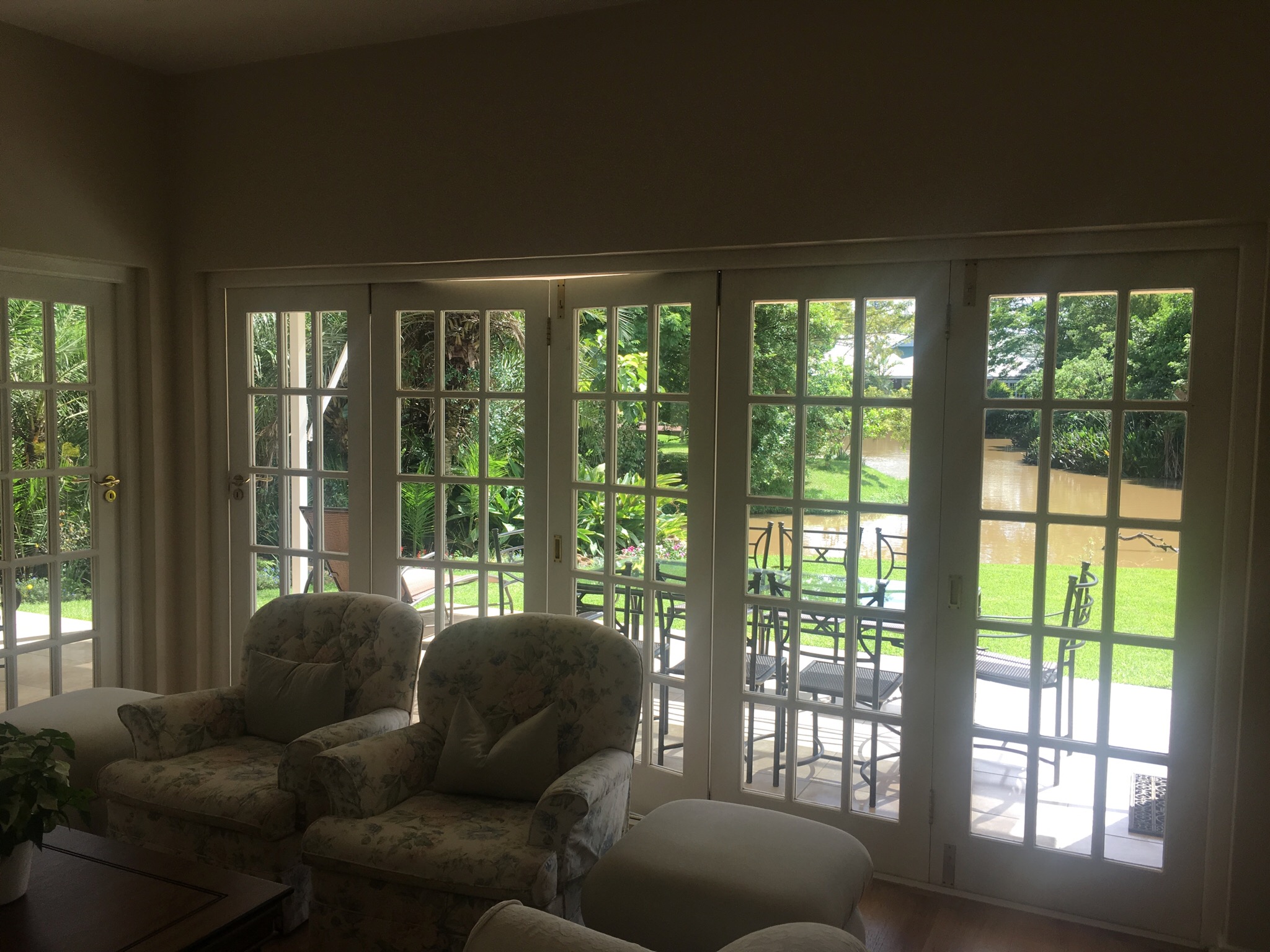
Peaceful setting
March 11 – After lots of discussion and input from Brian, we decided to drive from Durban to Cape Town through Umtata and Port Elizabeth, and to accomplish the travel over three days. We would end up in the Cape Town area on Monday evening. Up to this point, all of our accommodation was arranged before we left Canada. From here on, we agreed that George would find the accommodation on the internet based on our progress that day. So we left Brian and Linda early on Saturday morning.
For the first 100 km or so south of Durban, the roads were excellent and the neighbourhoods were quite pretty. Then after passing Port Shepstone, it was clear that we were in a different society – more agricultural and poorer. The scenery was exquisite. The travel was slower because of potholes and animals (mainly cattle and goats). There was more construction, too.
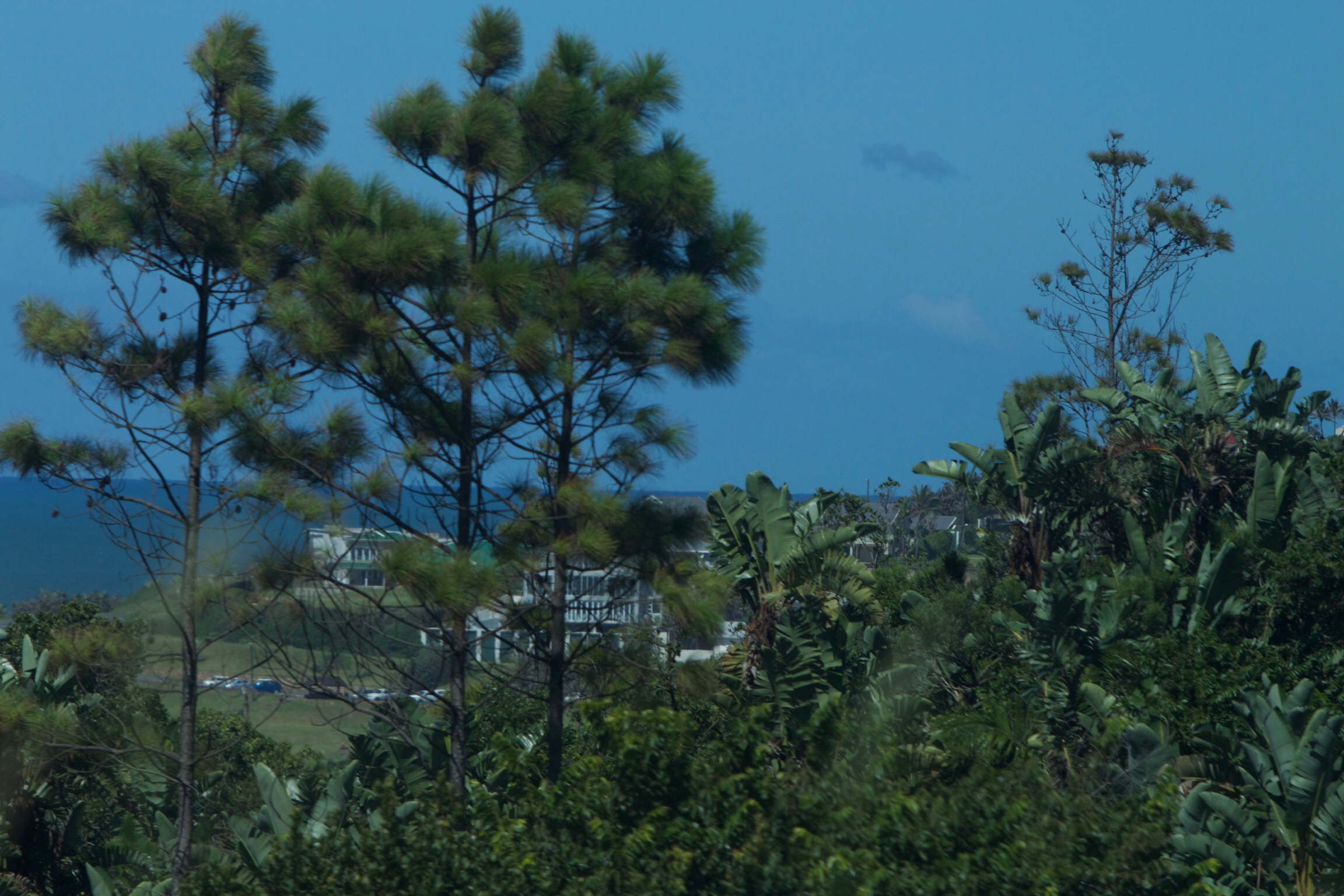
Gated community south of Durban

Rural African community
On Saturday night, we spent the night at Park Place Boutique Guesthouse in East London. Here, we shared a conversation with a fellow traveller, Edward, a Scot, who had worked quite extensively in Africa.
March 12 – On Sunday morning, we drove around East London. At one point, on a coastal road, we came across a Baptist Church whose members were just coming out of the church onto the street as we passed.
We took the long way out of town, seeing fishermen preparing at the seashore. We also came to the end of a rail line near the ocean, trying to guess whether the termination was planned or the result of a washout caused by a big storm. We also mistakenly found ourselves on a car race track. Being a Sunday morning, there wasn’t too much going on, though we did see some go-carts whizzing around in the distance.

Strange end to a rail line

Fishing on the Indian Ocean coast
This was the day when gas stations or the lack of them caused us to go back over some ground (as in East London) or to divert (as in Kareedouw). In each case, we were unsure that we had enough gas to make it to the next station. Better safe than sorry.
We had hoped to make it to George, then Plettenberg Bay, but with the diversion for gas, opted to stay at Tsitsikamma Spa and Lodge. It was very rustic, and was just fine for two tired travellers.
March 13 – Even though we had fallen a bit behind in our schedule, we checked out a really interesting area, Storms River Mouth in Tsitsikamma National Park, down by the seacoast. We hiked through a pristine forest area, ending up at a suspension bridge over a river mouth. I would guess that this is a road less travelled by most visitors to South Africa. There were surfers and kayakers in abundance.
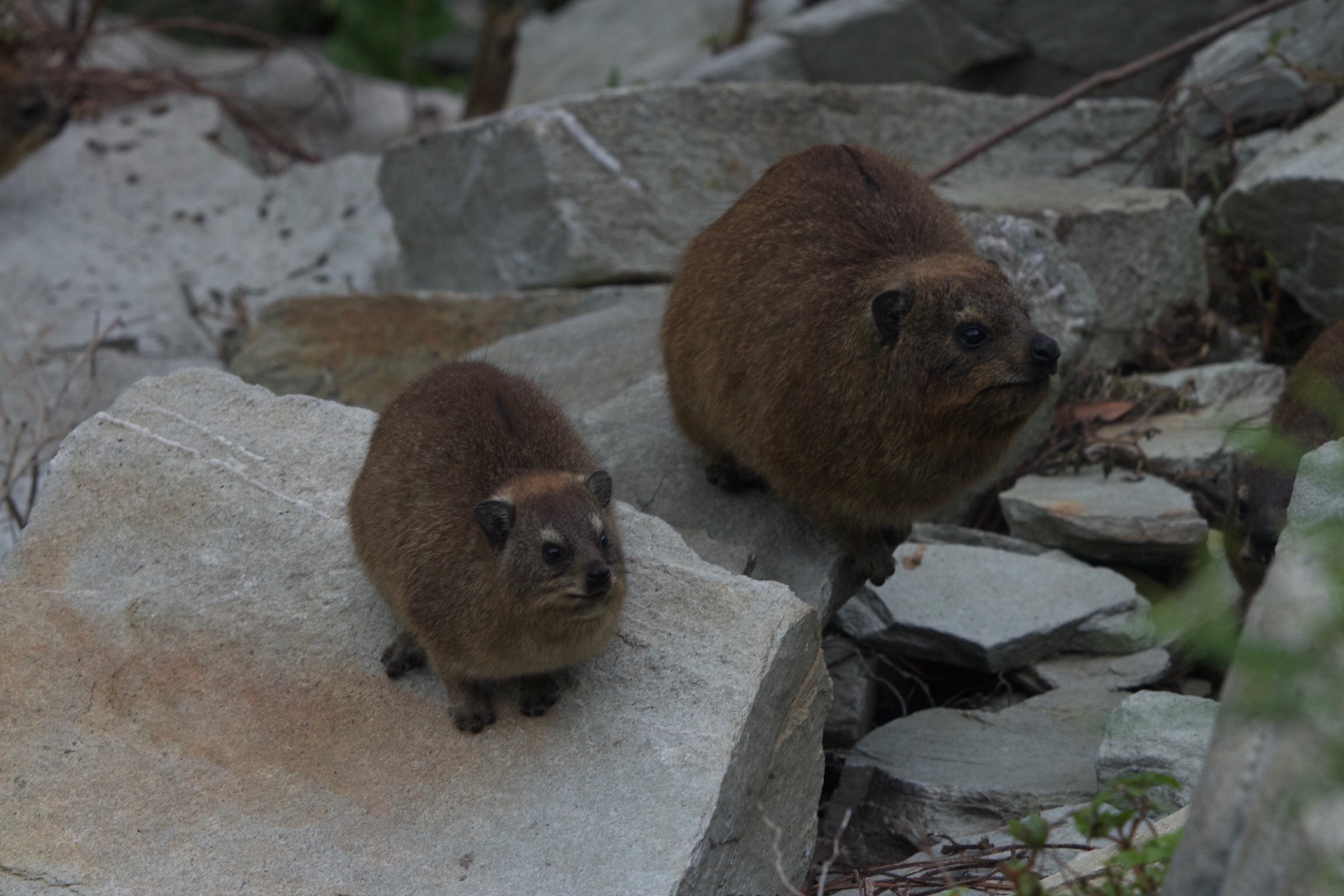
Wildlife
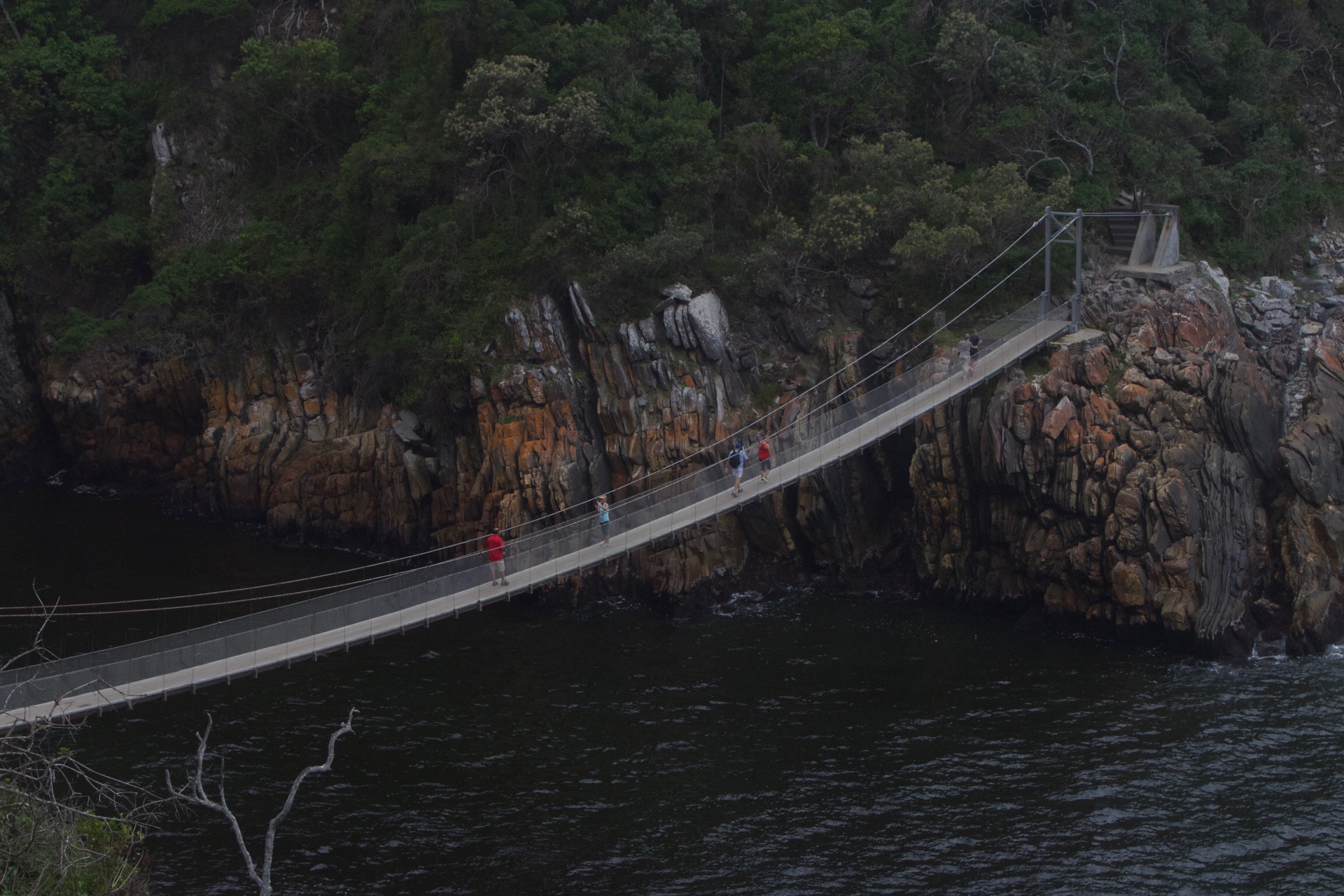
I crossed this!
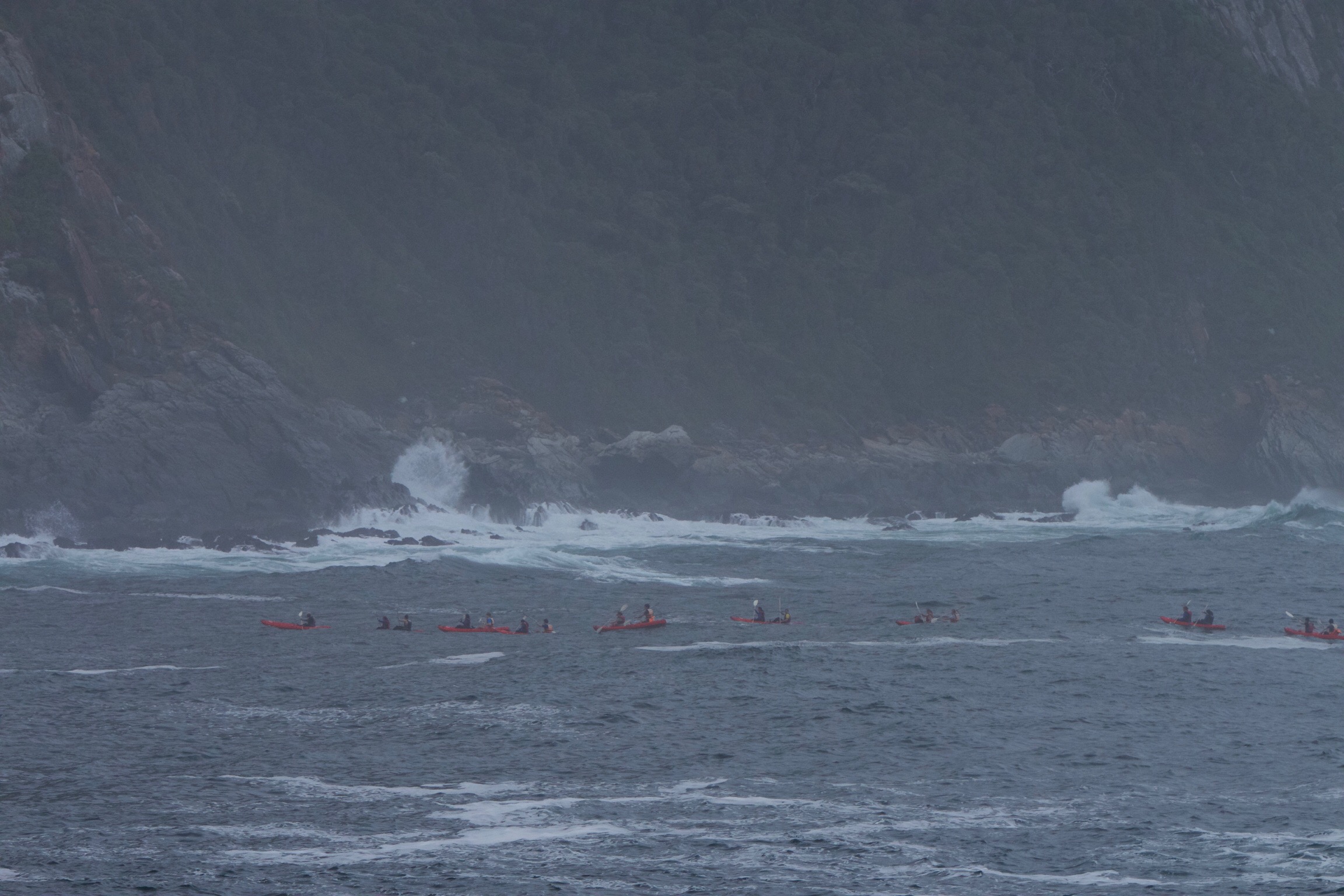
Kayakers
We enjoyed a nice lunch in Mossel’s Bay down by the sea. Though there were lots of birds in the area, they were very well behaved.
From here, we put the foot to the gas, and travelled through George. No, we didn’t stop at the George Hotel for nostalgic reasons. Nancy and I had stayed here on our trip along this route in 1979. Had we stayed at the George Hotel this time, my instructions were to purchase a “George” towel from the George Hotel!
At the Downies’ suggestion, we turned north at Swellendam to meet Highway 1 at Worcester. The scenery was absolutely fantastic, as we made our way towards Cape Town. There were vineyards as far as the eye could see. And there was an exceedingly long tunnel.
Knowing that our plan was to go to the Cape on Tuesday, George found Simon’s Town Guest House up on a hill in Simon’s Town. Our hostess was Australian, but had married a South African. They had built this guest house over the last ten years. It had a lovely rock garden and patio. But most critically, it had a lovely view of Simon’s Town harbour.
March 14 – On our way to the Cape, we stopped at Boulders Beach. Here George checked out the penguins. Or more precisely, the penguins checked out George’s 360 degree camera.

We arrived at Cape Point in mid-morning and set out on the hike to Cape of Good Hope, about half a mile to the west. Along the way were some beautiful sights looking over the cliffs. There were a couple of uncomfortable moments, too, as the path disappeared from time to time. Then we returned to Cape Point and took the funicular up to the summit. Up there, the baboons were a bit of a pest. Of course, the humans sometimes egged them on.
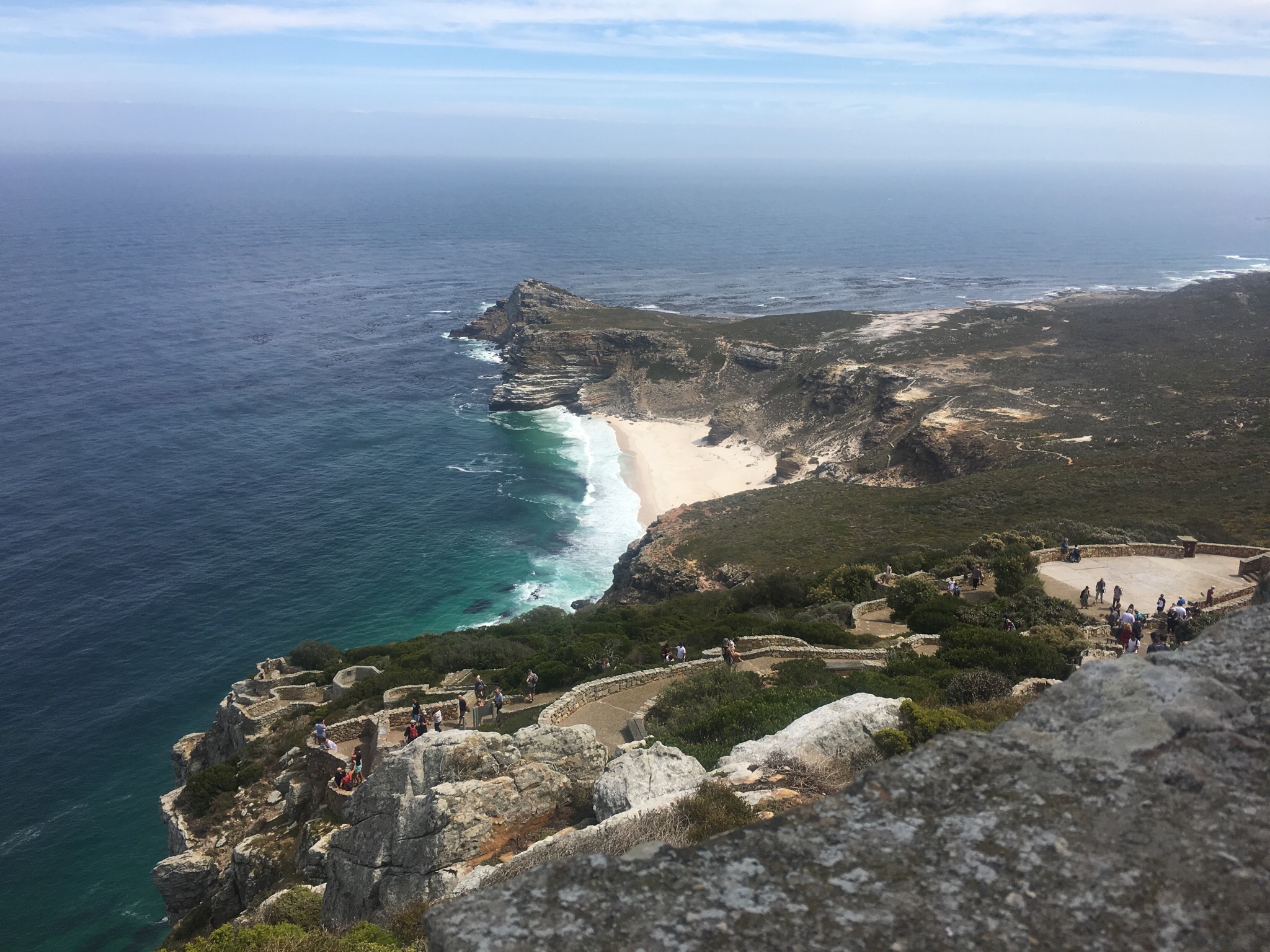
Cape of Good Hope from Cape Point
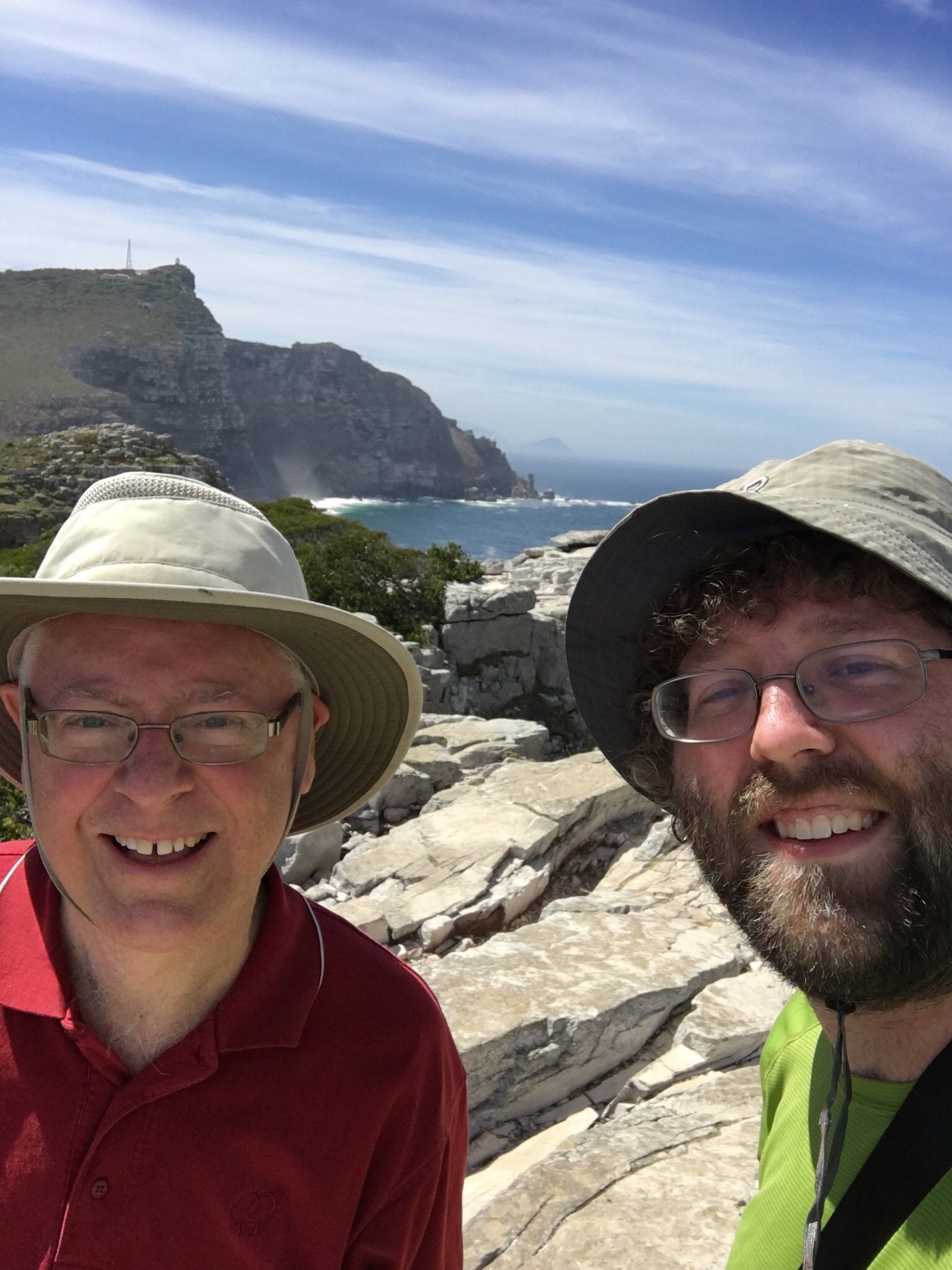
On the path from Cape of Good Hope looking back to Cape Point
On our return trip from Cape Point to Cape Town, we took the Atlantic Ocean side. Each village going up the coast provided a different view … Kommetjie, Chapman’s Point, Hout Bay, Llandudno, Camps Bay, and Sea Point.
George checked out the various suggestions that the Downies gave us for accommodation. He ultimately decided on Olaf’s in Sea Point. We stayed here three nights. It offered us easy access to Cape Town. In Sea Point, parking each night was an adventure. At least one night, we ended up parking four streets away.
March 15 – We had intended to go to Robben Island today, but found that the first ticket available was Thursday at 3 p.m. No problem. At least we had two tickets for Thursday.
We drove up to the Table Mountain parking area, surveyed the situation there and decided to take the On-Off Bus Tour of Cape Town. We started and ended the tour at Table Mountain, which ended up being a good decision, although it forced us to shorten an intriguing tour at Kirstenbosch National Botanical Garden. Viewing this garden from the Boomslang (the new steel and timber canopy walkway) was a highlight.
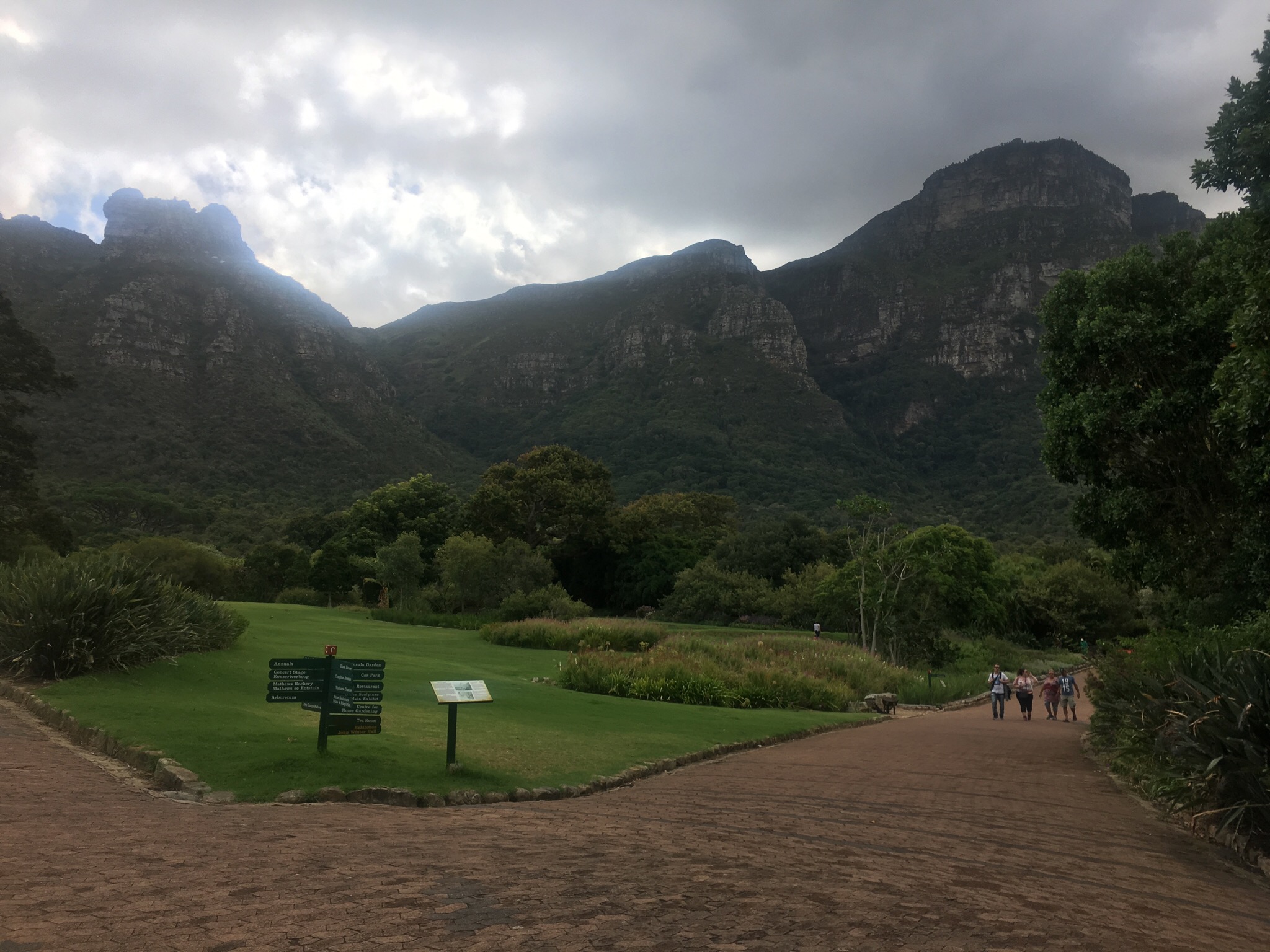
Natural landscaping in the Gardens

A unique view of the gardens from the catwalk
We arrived back at Table Mountain in time to take the cable car up just as the sun was setting. Spectacular!
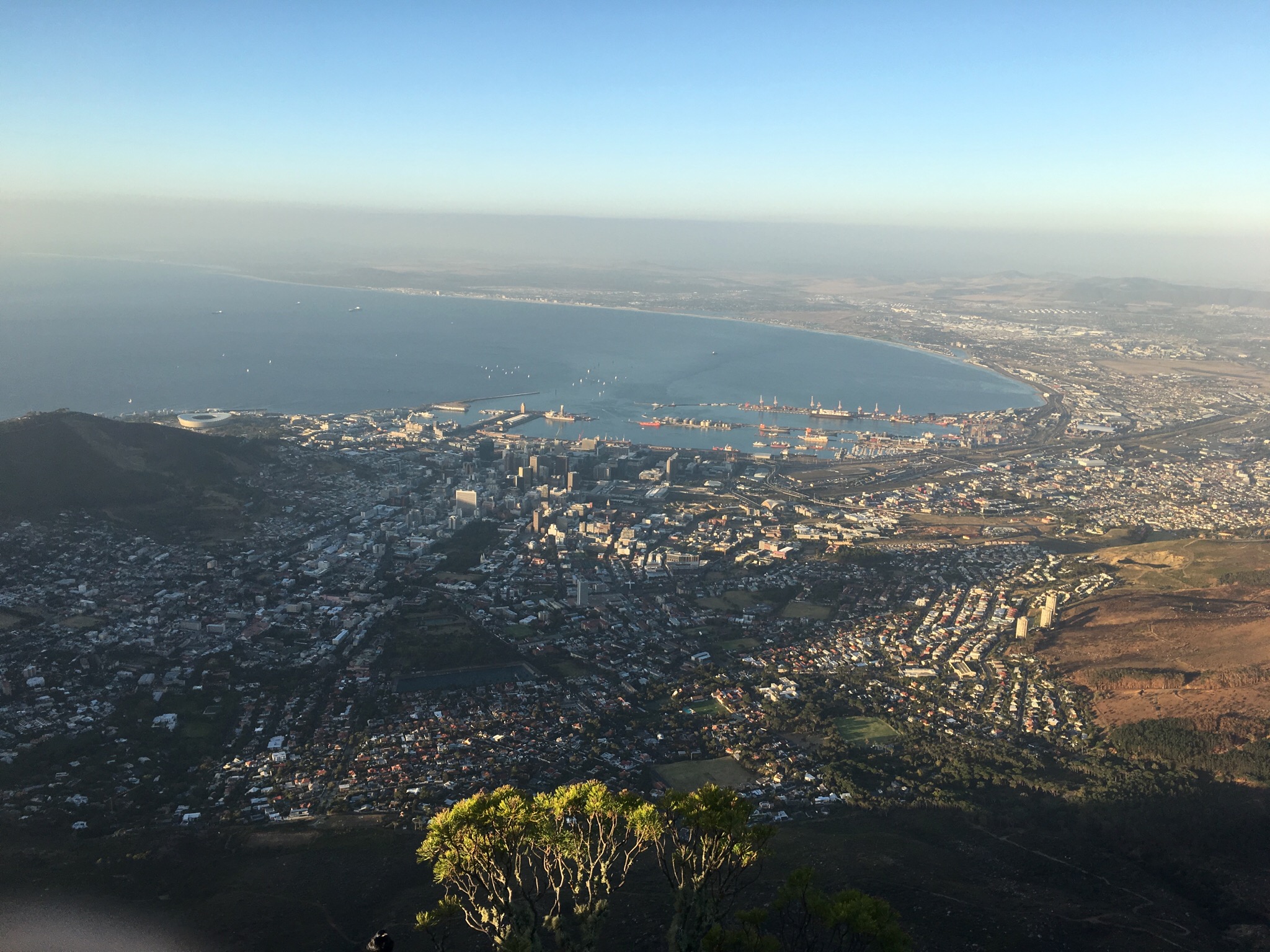
Cape Town from Table Mountain

March 16 – This was a quiet day other than the trip to Robben Island.
We drove together to the beach at Sea Point. George rented a bike there to ride down to the Dock area of Cape Town. After a short walk up and down the boardwalk, I drove downtown. We met at Nobel Square where lifesize statues of Mandela, de Klerk, Luthuli and Tuti are situated. We enjoyed a short walk in the area before having lunch at a Portuguese restaurant. Other nationalities were represented in the restaurants of the area, including Belgian and Thai.
Before taking the ferry over to Robben Island, I spent some time checking out the display area in the building adjoining the ferry dock. Then we were off, and within about 15 or 20 minutes we were on the island.
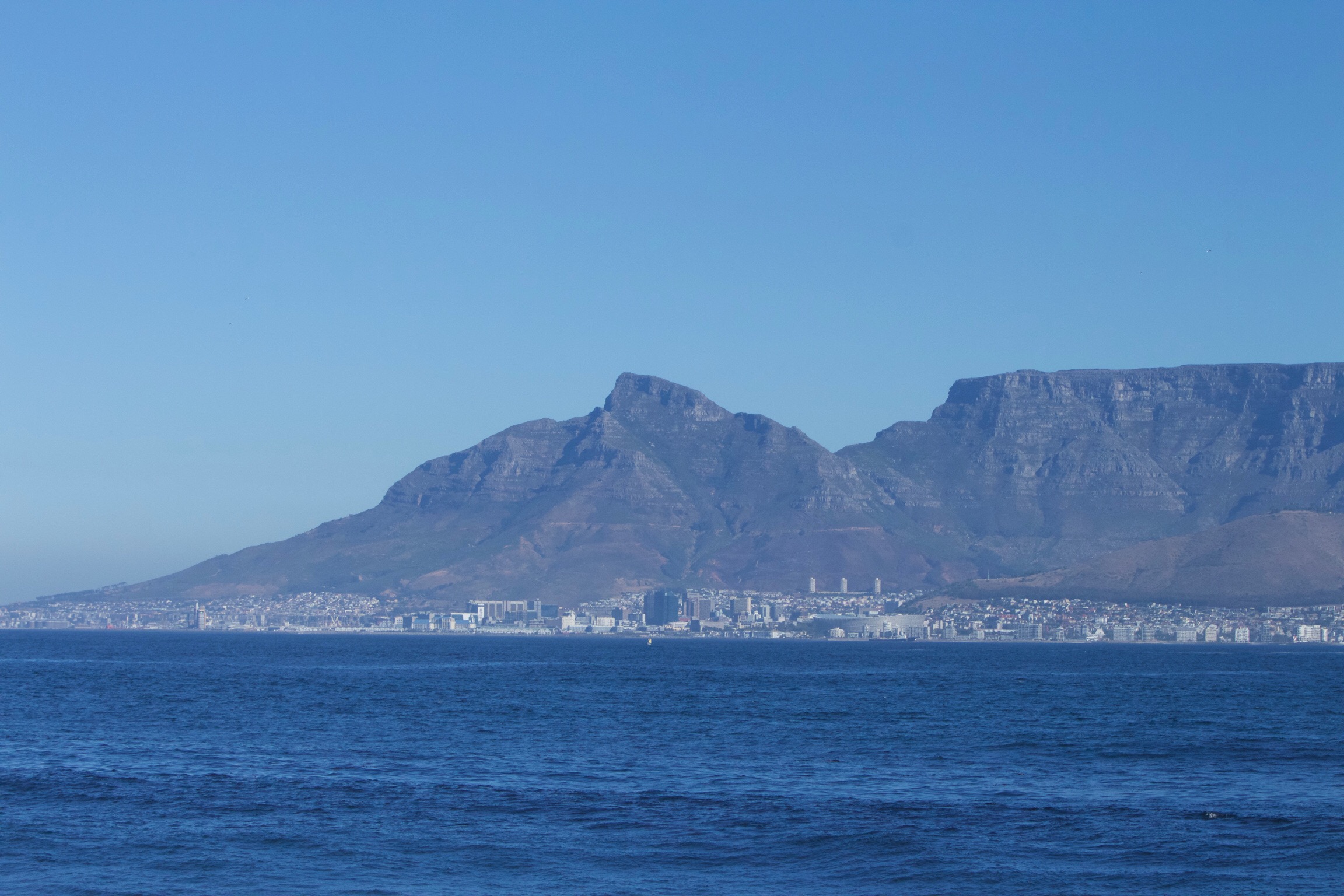
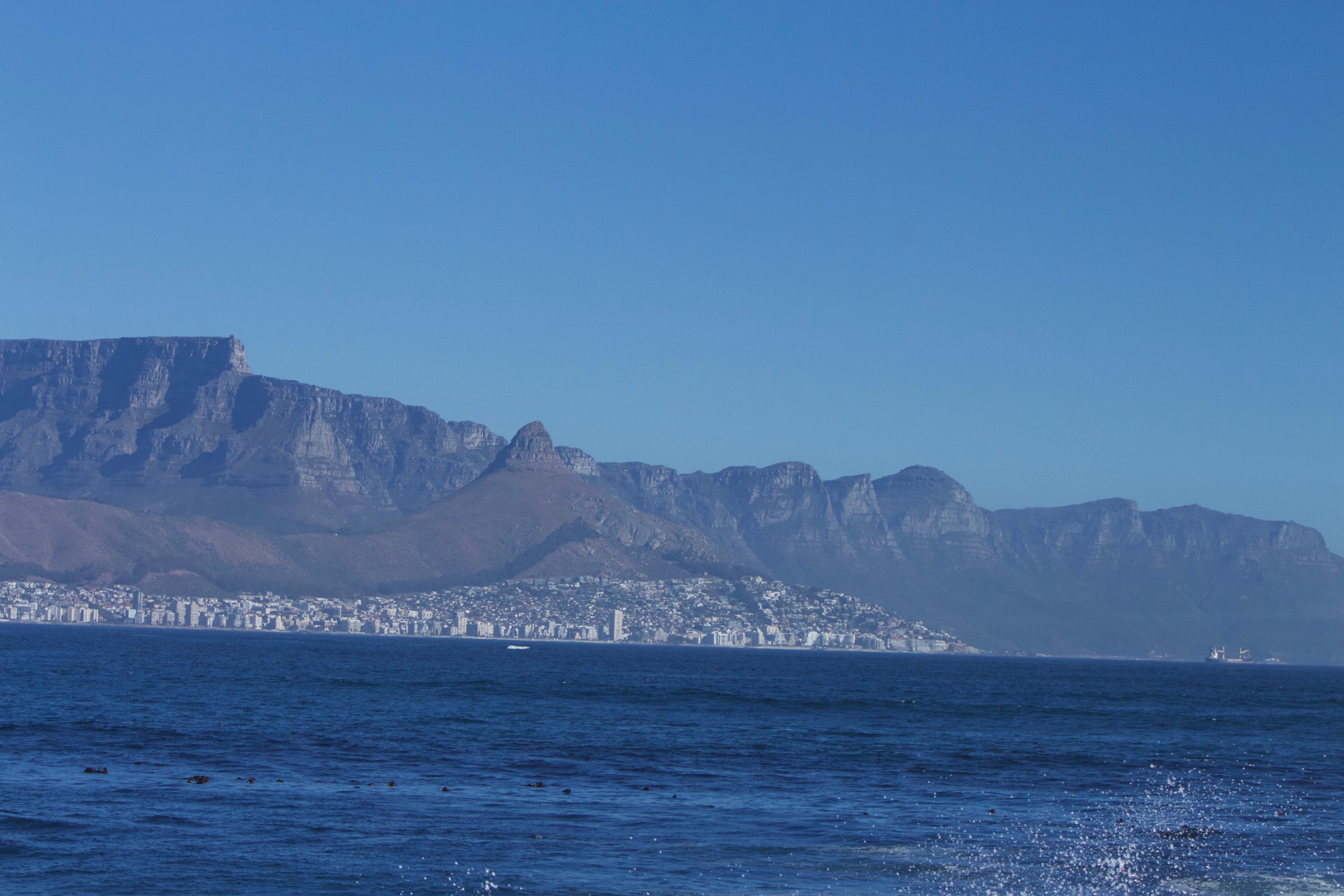
On the island, the tour is pretty standard with stops at different buildings. The island has been used for different purposes over the years – mainly for political prisoners and lepers. We saw the lime quarry where the ANC prisoners worked, and we walked through the prison block, and viewed the actual cell where Mandela lived for 18 years. Much of the prison portion of the tour was led by a former political prisoner who was incarcerated at Robben Island for about six years. He was there after Mandela was transferred to a facility on the mainland. It is very powerful to have an ex-inmate lead the tour. Cape Town and Table Mountain are tantalizingly close. Over the years, only one or two have successfully swum from Robben Island to the mainland.
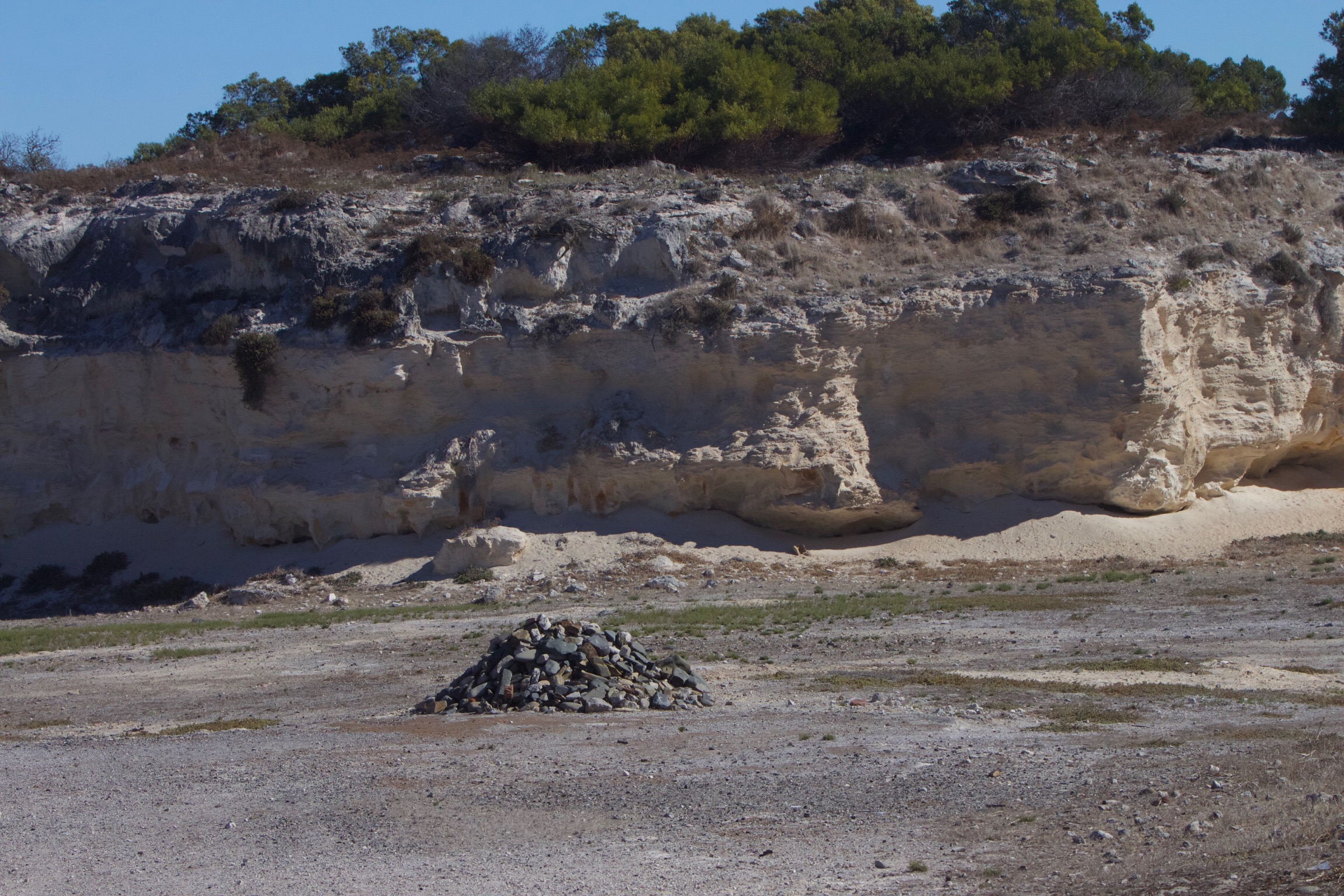
Pile of rocks put there in 1994 by Mandela and other prisoners
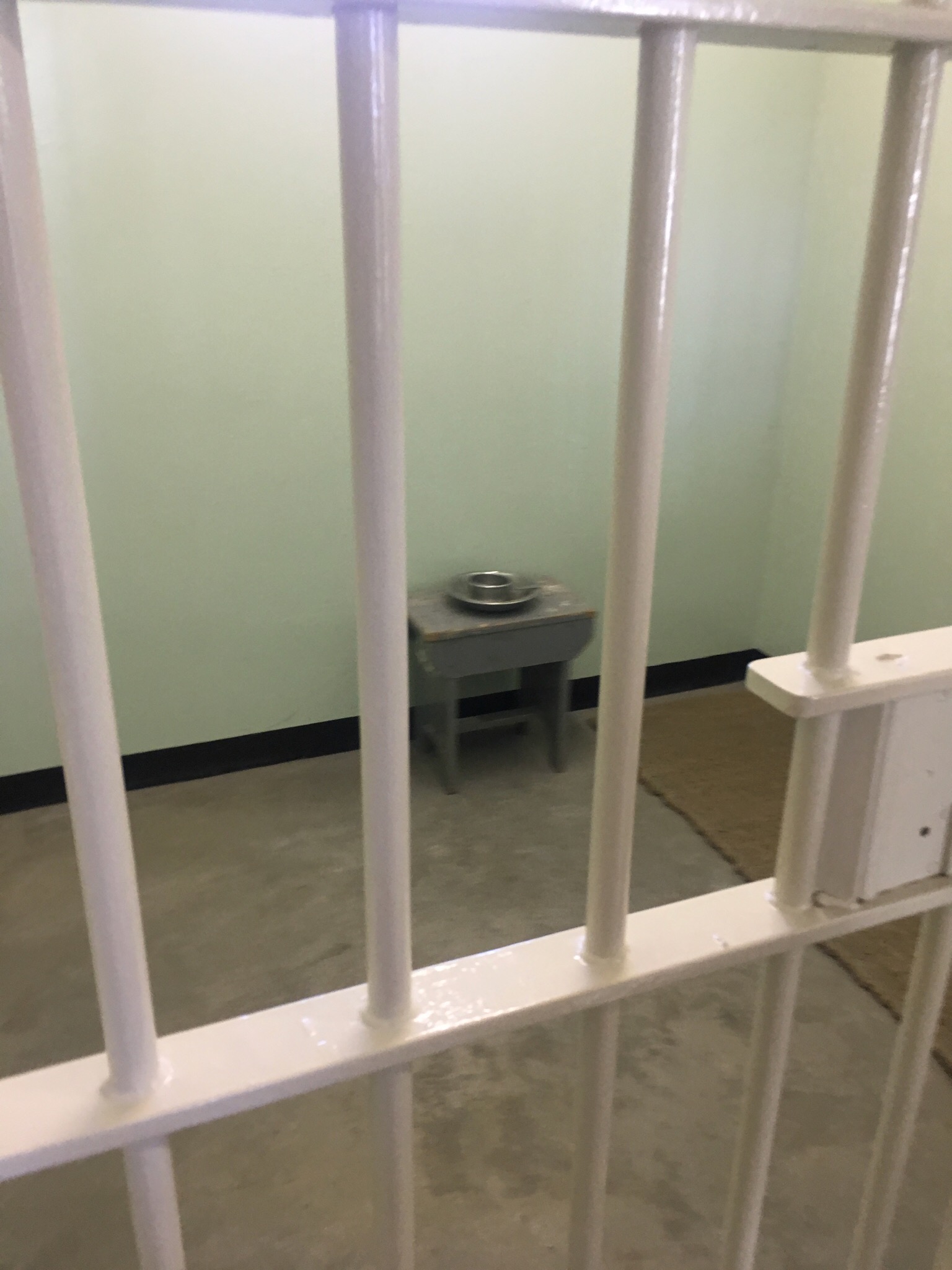
Mandela’s cell
We then returned to Sea Point for our last night. Each night in Sea Point, we ate at a different restaurant, one night at the Raj in Camp’s Bay, then at Mykonos Taverna, then at Jerry’s Burger Bar. We had hoped to dine at Hussan’s Grill, which was recommended by Brian and Linda, but found that one needed to make a reservation. Because of our busy schedule, that was difficult to do. Hussan’s will have to wait for a future trip.
March 17 – Today was a travel day. That meant that we had to pack for our next set of air flights. This is a bit more involved than the regular day-to-day packing from one hotel to the next.
Before going to the airport, we decided to tour a number of lesser sites in Cape Town. The first spot was the Castle of Good Hope. The Castle was constructed between 1666 and 1679. We arrived in time for the key ceremony, the firing of the signal cannon, and an hour-long guided tour of the facility.
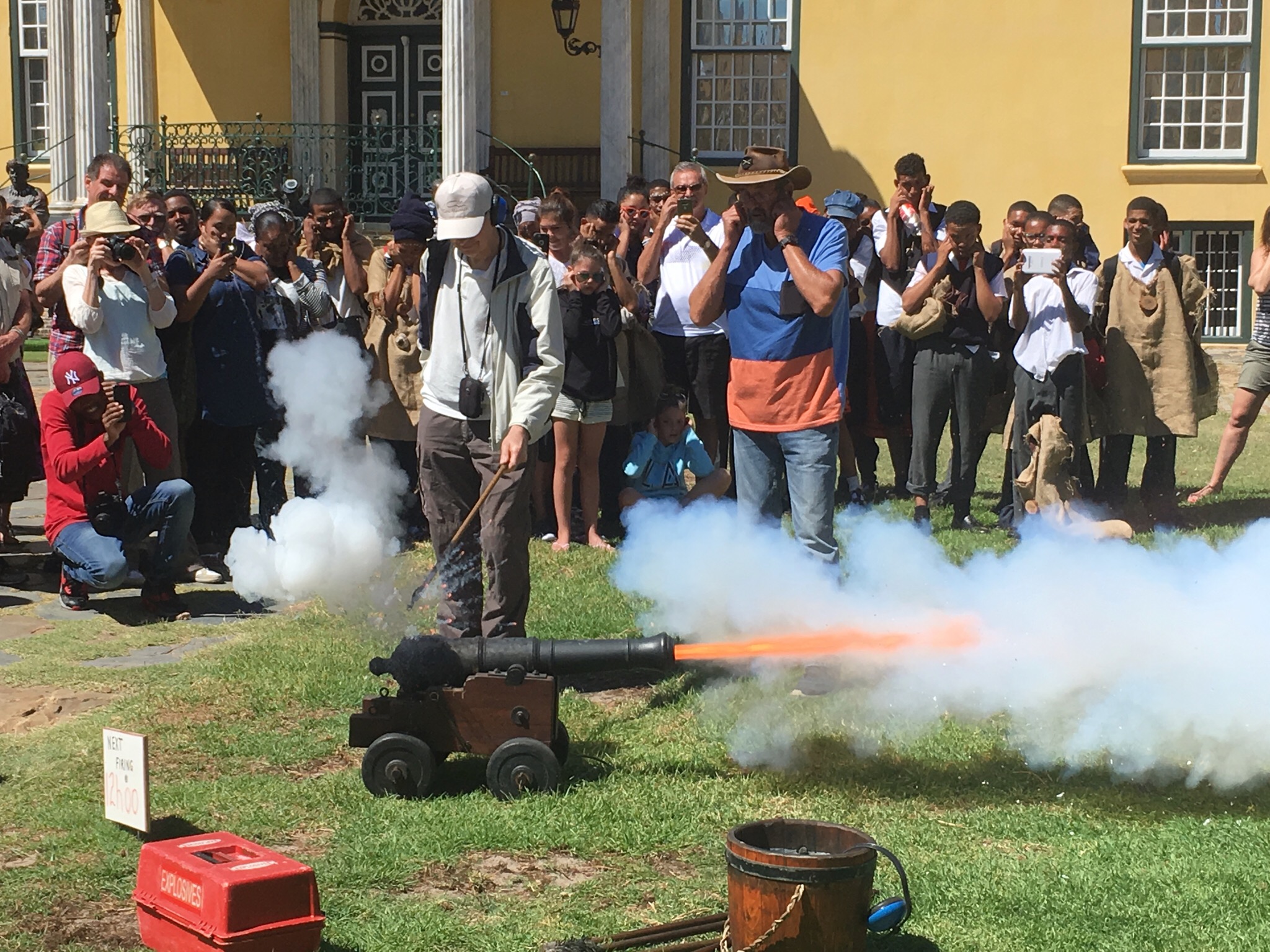
The second spot was the Company’s Garden. We had read that the Planetarium there had a special show on the Southern Night Sky. When we arrived, we found that they were closed for renovations. Undaunted, we took in an exhibit of African history and culture in southern Africa at the adjoining museum instead. Then we walked through the Company’s Garden area including brief stops at the Parliament Building and the Anglican Cathedral. Important anti-apartheid demonstrations occurred in this precinct in the 1980’s and 1990’s.
After a brief hassle with an aggressive local vendor in the park, we took our leave of Cape Town.
We filled the gas tank at the airport, returned our faithful Corolla, and began the last leg of our trip – from Cape Town through the Addis Ababa airport to Entebbe.
March 18 – We arrived at Entebbe around noon. Initially, confusion abounded. The staff ran out of Immigration Forms. That certainly was a new experience for me. After a short time, new stacks of forms appeared and all quickly returned to normal.
Our travel companion and guide, Brian, met me outside the terminal, while George was getting his phone fixed for use in Uganda. Then the three of us headed up the busy Entebbe to Kampala road. An expressway is almost finished. One slow truck can affect traffic on the existing two-lane road.
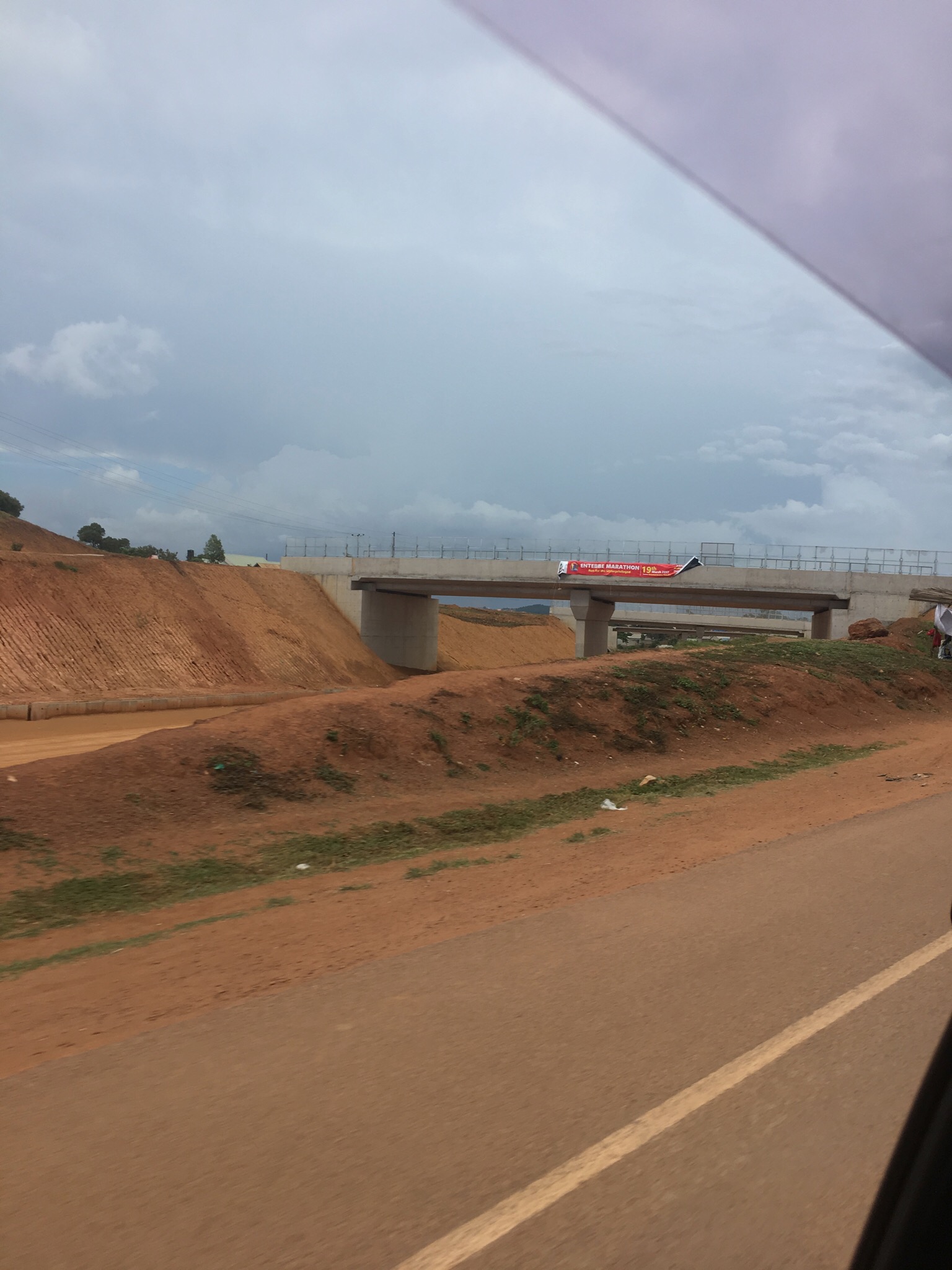
New highway will speed up the trip into Kampala
Lots of familiar sights jumped out at me as we drove along. There were some new ones too. My initial impression is that this stretch of road is a lot busier than it used to be.
We arrived at Makerere Guest House to discover that what I had arranged – one room with two single beds – was not available. Another larger group, a university dance group from Norway, had taken up all rooms of this category. We ended up with two single rooms for the same price. It left me with a bit of a sour taste that an email confirmation was not secure and freed me up to consider, with Brian, what we might do instead of staying close to Kampala. Of course, the options had to be reasonable in cost and available on short notice.
In the end, we decided that we would try to arrange a two-night visit to Murchison Falls National Park in the north-west part of Uganda.
Shortly after Brian left, Marion Sonko arrived for a short visit. Marion is the widow of a former teaching colleague at the Aga Khan Secondary School. Nancy and I stayed with them in 1979 and corresponded frequently after our return home. Of course, she knew George Jr from our correspondence (up until the early 1990’s), but it was the first time she had met him. Later her daughter-in-law, Jane, and grandchildren, Daniel and Timothy, joined us.
After our guests left, George and I had dinner at the Guest House and retired for the night. It had been an exhausting day.
March 19 – On the way to Makerere the previous day, Brian had driven us by Kampala Baptist Church and the Aga Khan Secondary School. We noticed that the road leading from Makerere to both places was under construction, and with rain would be a sodden mess.
We arranged for a ride to the church in time for the 11 a.m. service. There was a pretty good turnout. Since I had written in advance to prepare them for my visit, they were open for me to bring greetings as an attendee from the 1970’s and as a fellow Baptist from Canada. The message was on the Holy Spirit and the senior pastor responded to questions at the end of the sermon.
After church, Brian took us for a short tour of downtown Kampala, then delivered us to Marion’s home for lunch and a visit. Of course, a Sonko lunch is a feast. We enjoyed salads, meats, rice, Irish potatoes, sweet potatoes, squash and matoke with groundnut sauce. Before and after lunch, we had a variety of fruits including mango, watermelon and pineapple. Over the course of the afternoon, various neighbours helped serve some of the dishes that they had prepared. Marion’s two surviving daughters, Dumalie and Salome, and one son currently in Uganda, Andrew, joined us along with Jane. Her two boys ended up playing soccer with George for a while.
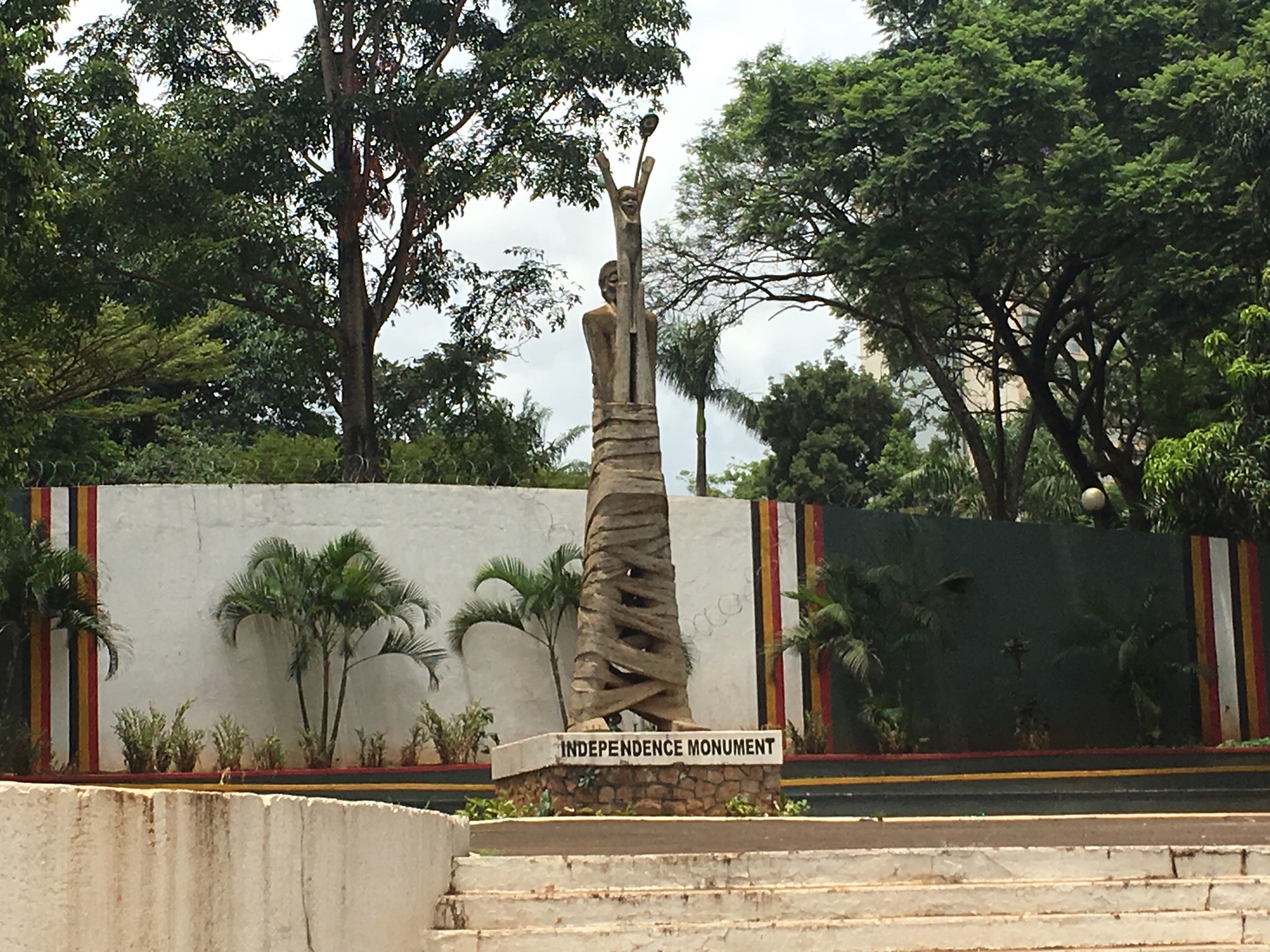
Independence Monument in downtown Kampala
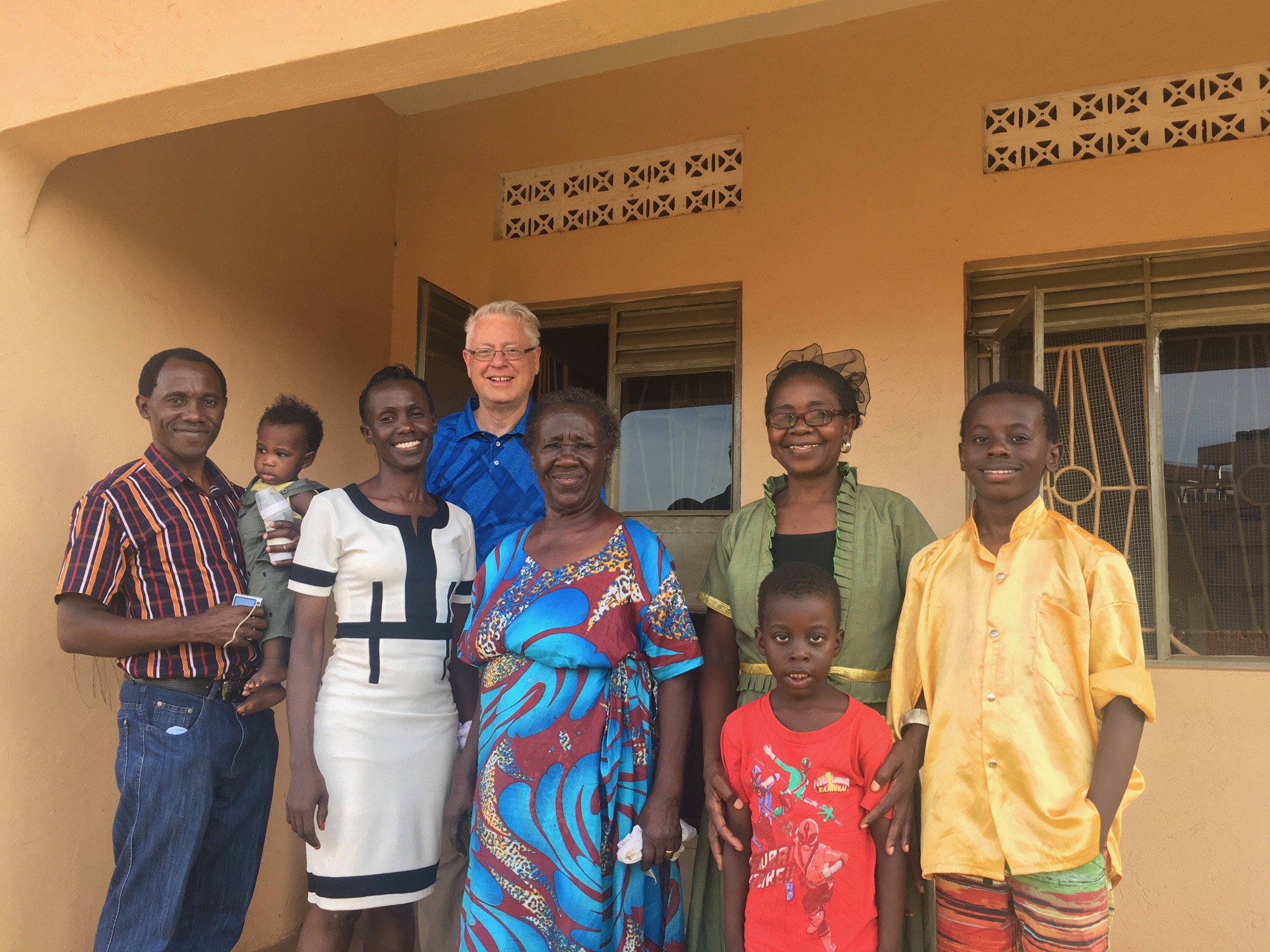
Marion, daughters Dumalie and Salome, son Andrew and grandchildren
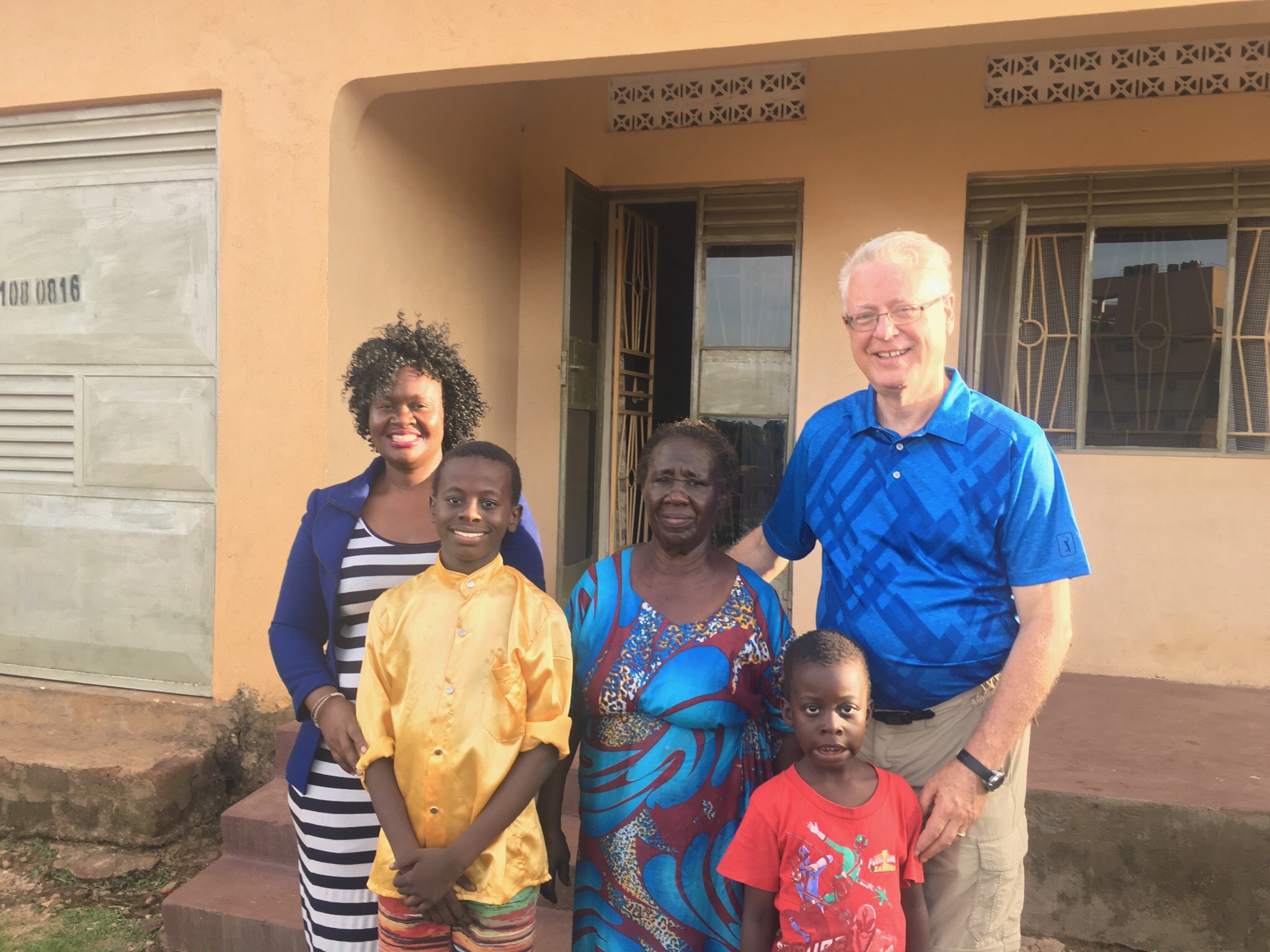
Marion with daughter Jane and grandchildren
Marion has a nursery school on her premises. My sense is that at age 79, she is living a very busy life.
Over the two days with Marion, we showed her and her family the pictures of the Aga Khan staff, presented her with some Canadian maple syrup, two issues of a black girls magazine from Toronto, and the Measha Breuggegosman Spirituals CD. She gave us some Mango Juice, mini-bananas, and ground nuts for our travels. We took lots of photos, too.
Brian took us to a cultural show at Ndere Cultural Centre for the evening. The musicianship and the dancing was remarkable.
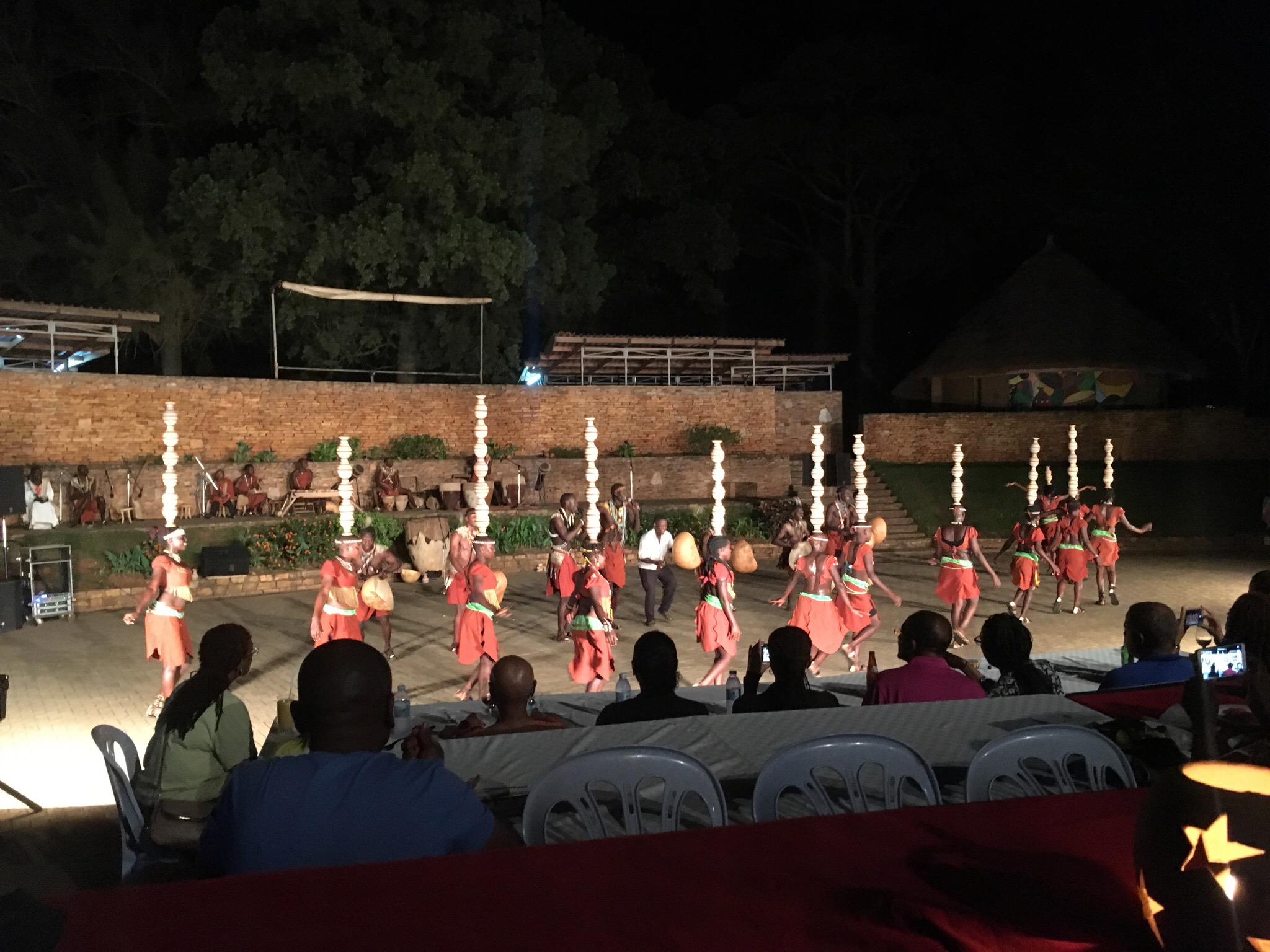
Cultural show – dancing with china bowls on one’s head!
March 20 – Today, we visited Aga Khan High School for about an hour and a half. Enoch, another of Marion’s sons, had arranged this visit with one of the staff, Pauline. We began with a visit with Fred, the African CEO for the Aga Khan organization in Uganda. Fred described the current set-up of the school. In the former Secondary School, the International Program is housed with classes running from Nursery School to Form VI. In the former Primary School, the National Program is housed with classes running the same range. Across the street is a building with one floor housing the Aga Khan University, and the lower floor housing a younger Nursery School. There may be some changes in the future involving the old Secondary School building in Kololo.
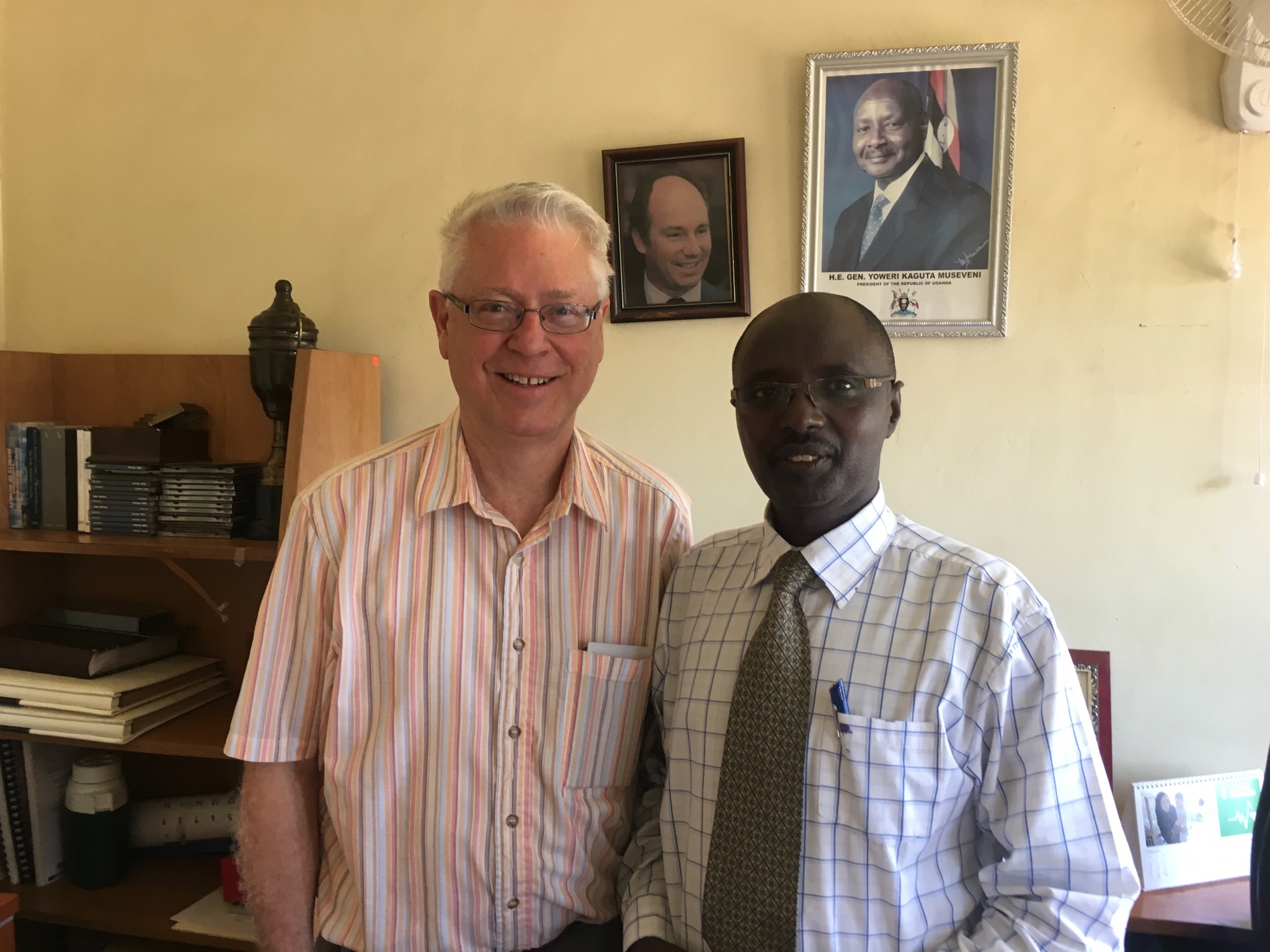
Next we had a brief meeting with the School Head, Reeshma Charania. Subsequently, she took us on a short tour of the school, showing us my old home room, the Science labs, the Art room and the school grounds behind the school. I believe there has been a modest amount of extension since I was there. But the school with the open central courtyard remains.
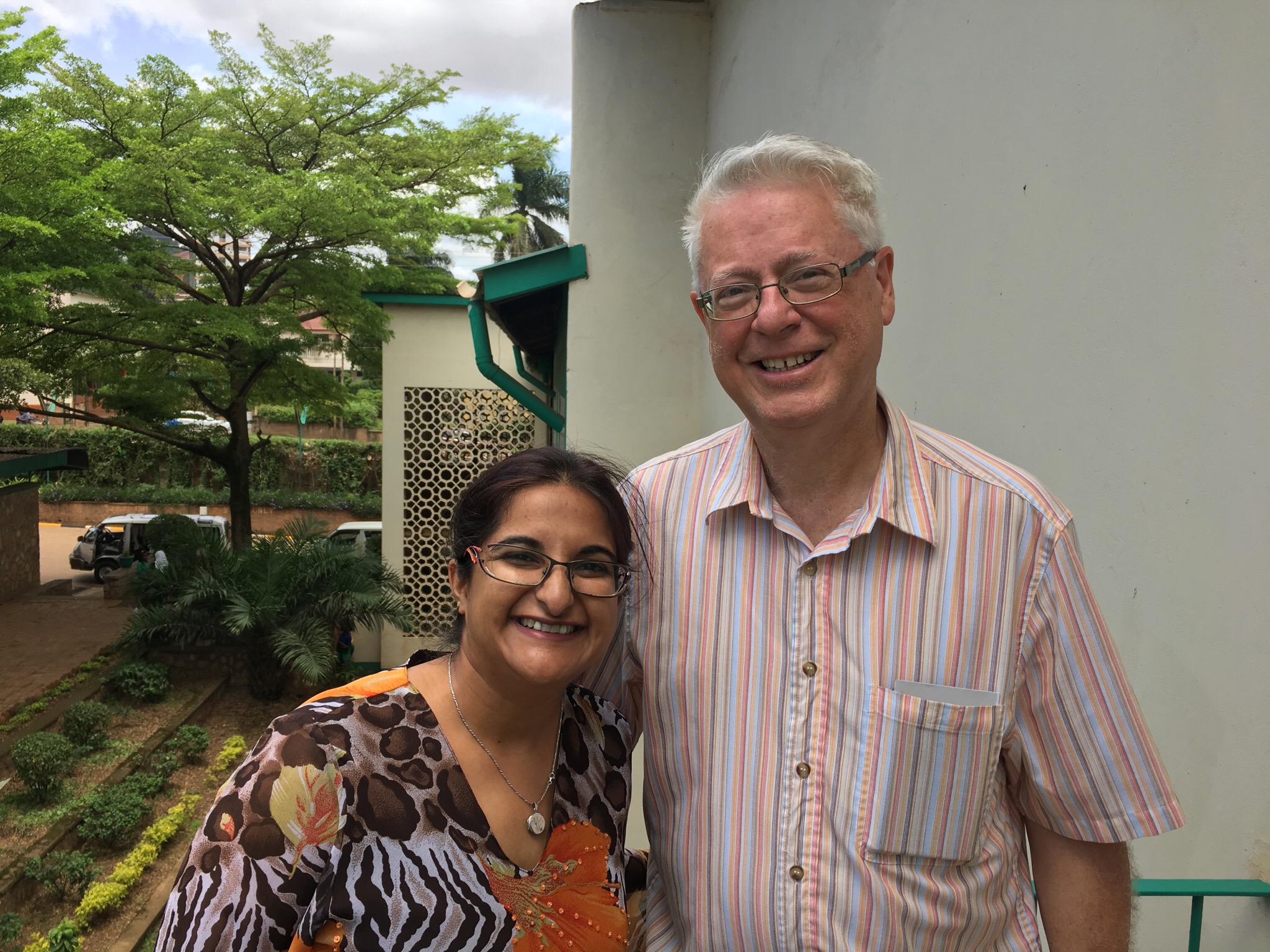
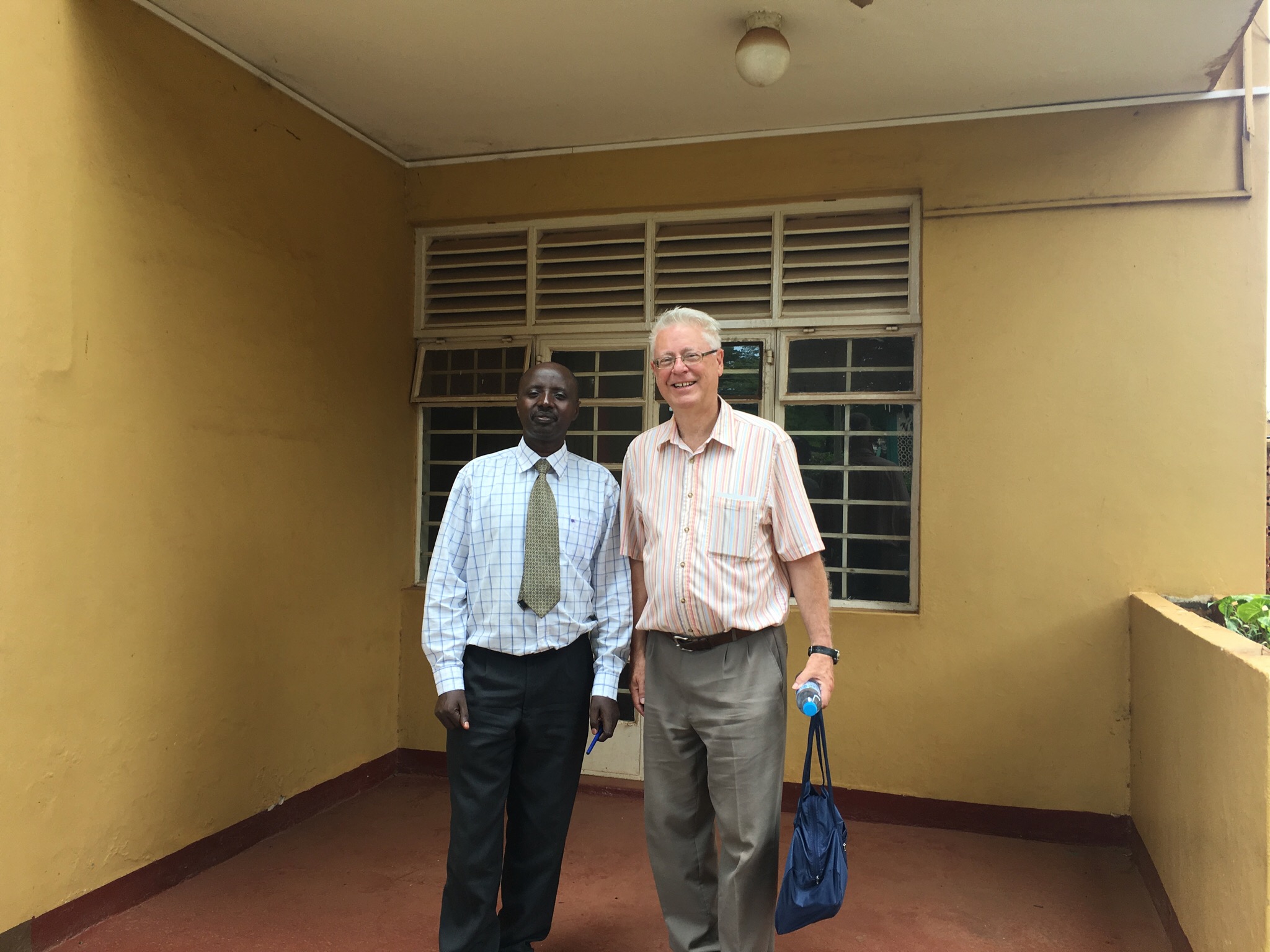
Fred then took us for a short walk across the road to the Aga Khan flats. The unit I lived in was empty and ironically Fred had previously lived there too. George took a photo of Fred and me, then a 360 in the garden. The nursery school has appropriated some of the garden. We then returned to the other side of the road and reconnected with our guide, Brian.
Brian then whisked us up to Murchison Falls National Park. The last hour or so, from Masindi on, was on muram (compacted mud road). We arrived just in time to get unpacked in our Red Chili Rest Camp cabin, then have dinner. The central building was combination admin and restaurant. Inside the building was the kitchen. Next to it, covered but outside was the eating area. Further was the campfire with seats and benches adjacent to the eating area. Before we went to the campfire for conversation, we ordered our breakfast for quick takeaway the next day. The three of us enjoyed the campfire, and shared some campfire stories before retiring for the night.
Before turning in for the night, we were warned that nighttime trips to the washroom should be lighted by flashlight as hippos and warthogs sometimes visit.
March 21 – We arose bright and early, collected our breakfast bags (mine was 2 beef samosas, a banana muffin and a slice of watermelon), and drove off to the ferry to take us across the Victoria Nile to the northern section of the park, where the animals are more numerous.
We met our guide for the morning, Robert. Brian and I sat in the front, and George and Robert sat in the rear. George had the option to stand up through the vehicle roof to take pictures.
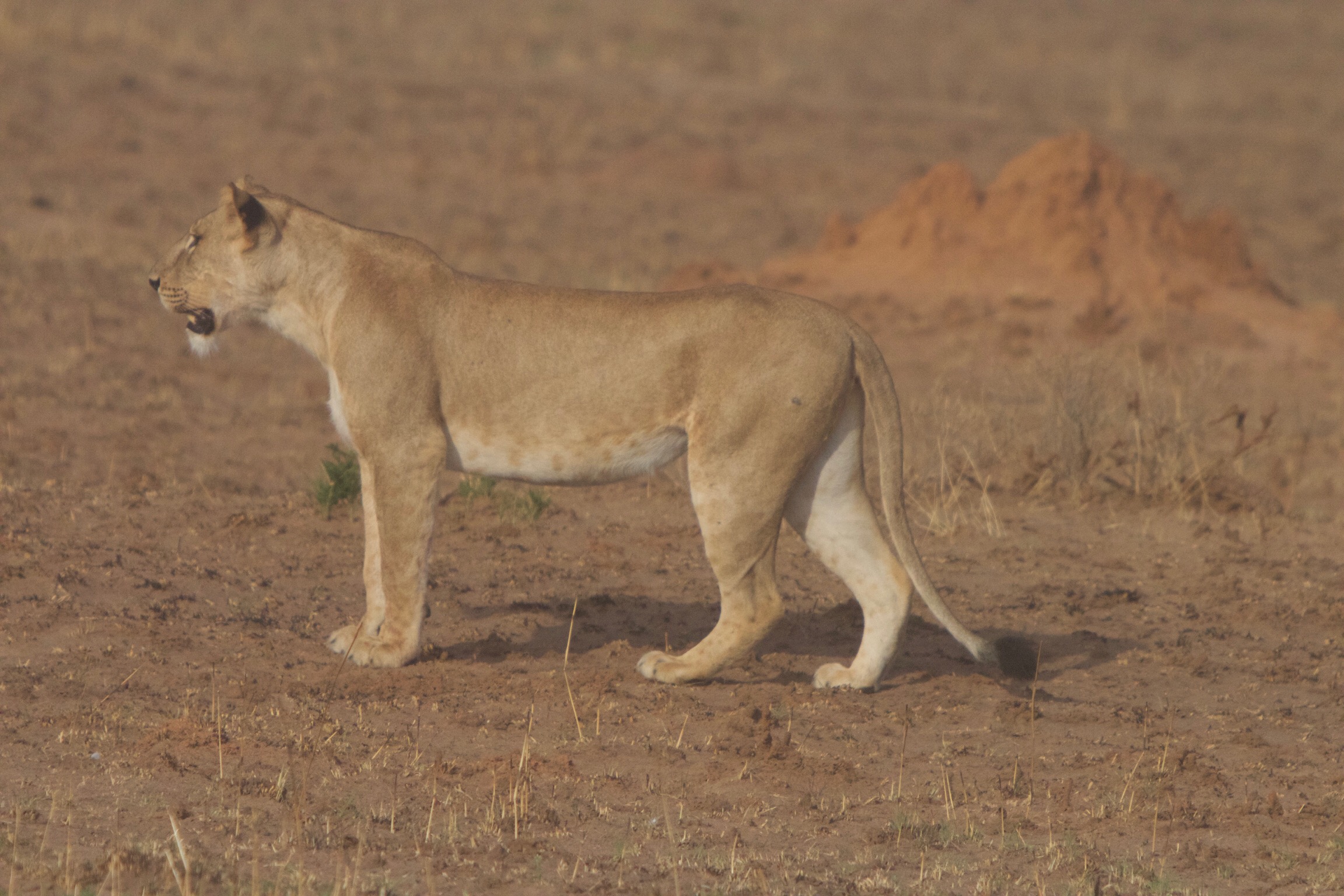
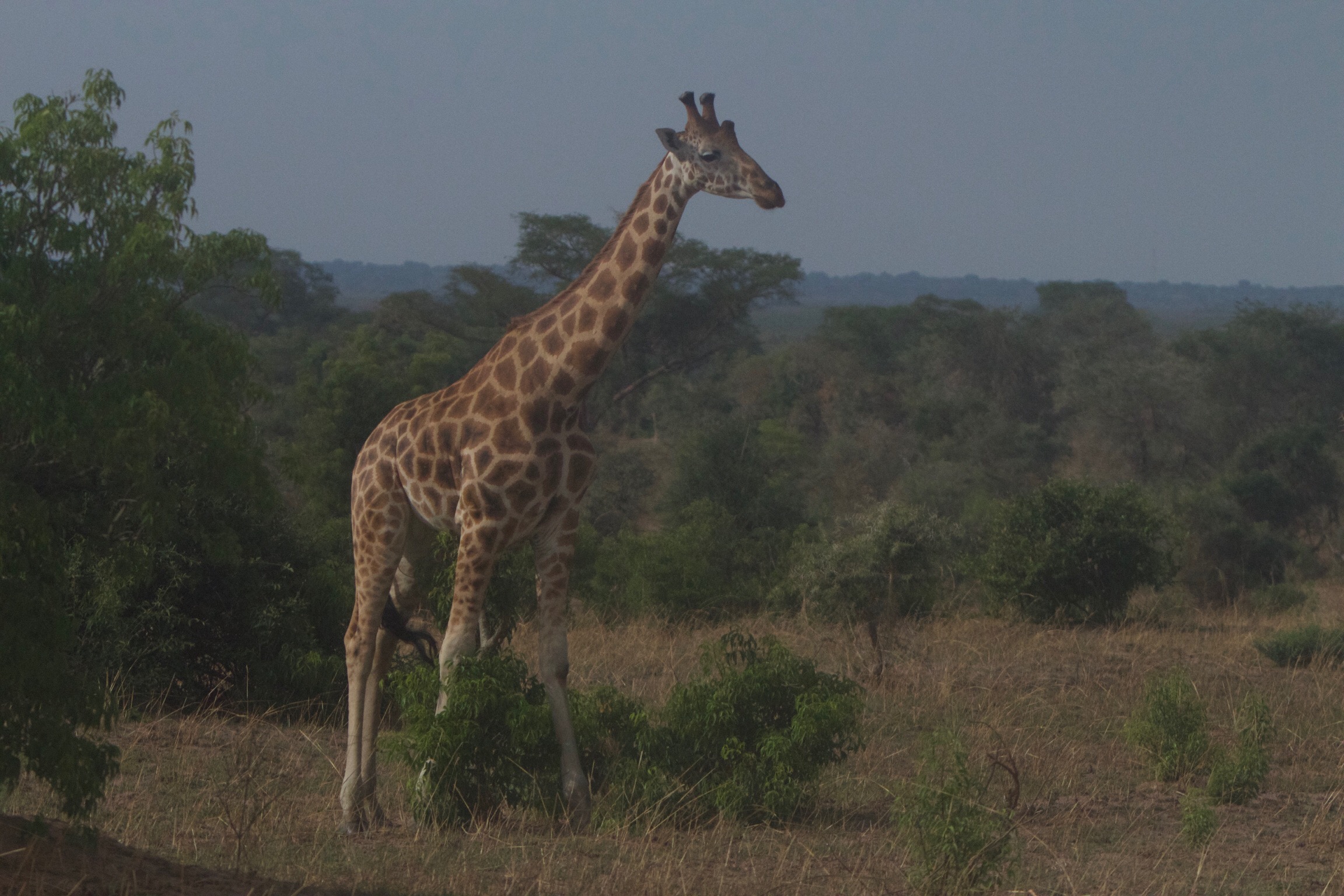
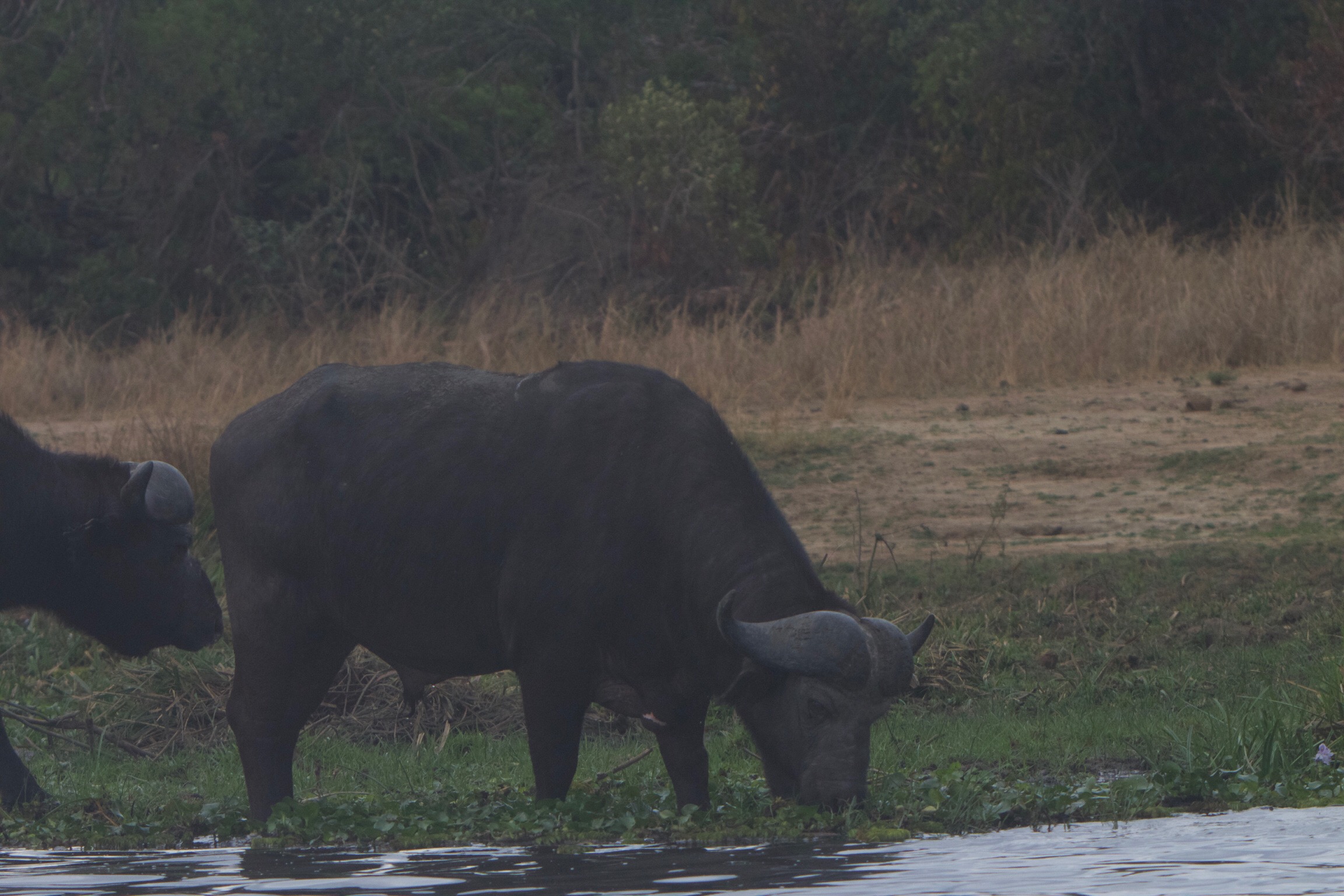
We saw a multitude of animals – female lions, buffalo, elephants, warthogs, various antelope, baboons, giraffes, jackals, and a variety of birds and small animals. The highlight was to see a trio of female lions hunt and kill a young oribi. One lion took the lead and after pawing the captured kid for a few moments, finally put it out of its misery. We didn’t stick around to watch how dinner was eventually divided, but my guess is that the lead lion was satisfied before the others had their turn. Next, we headed up to the Albert Nile to see the hippos and the crocodiles.

After we parted with Robert, Brian took us to Paraa Safari Lodge for a buffet lunch. We enjoyed seeing how the other half live. For a Double Room, the current Bed and Breakfast is $318US. The Queen’s Cottage, built for Queen Elizabeth, costs $839US.
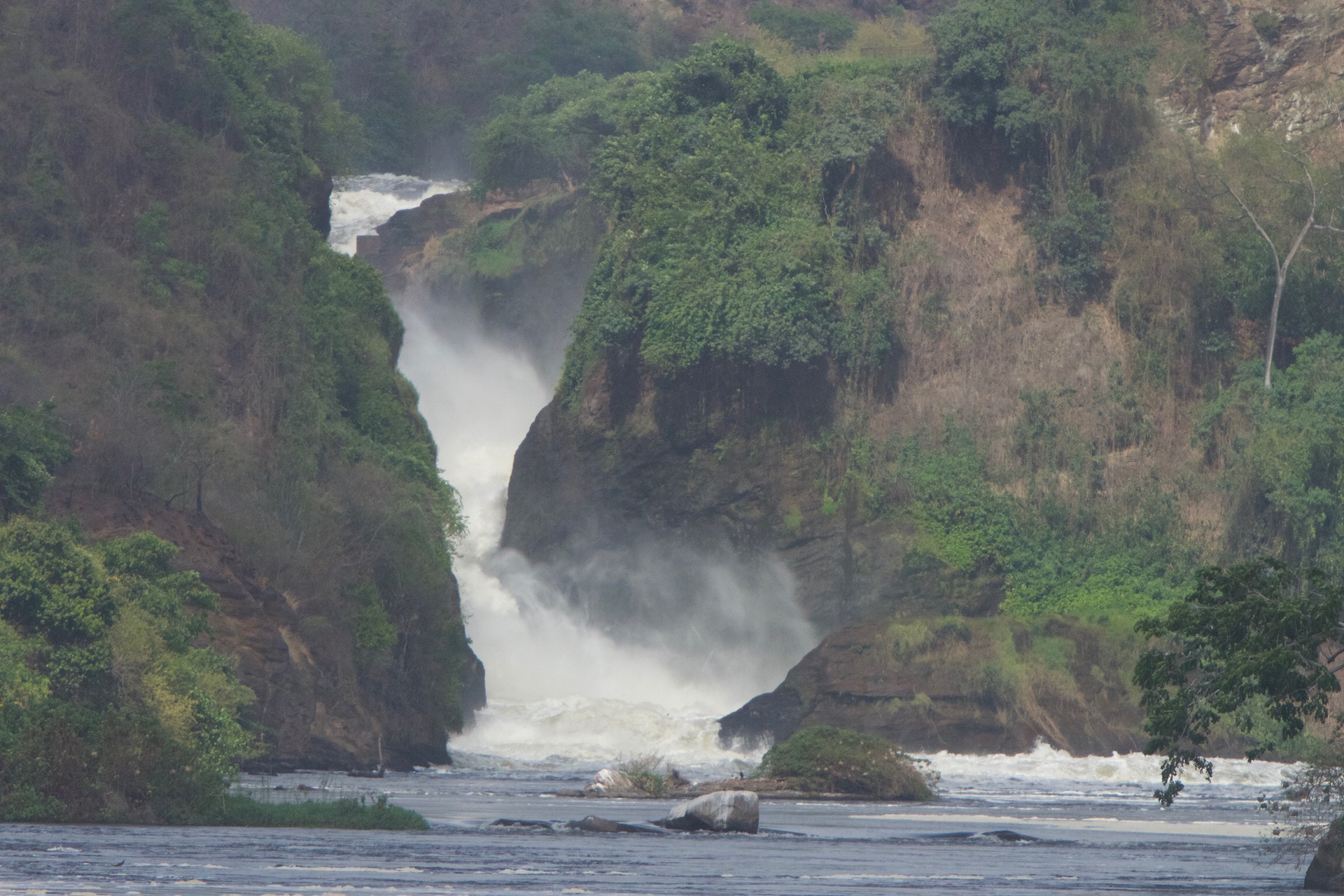
In the afternoon, we took a river cruise up the Victoria Nile to Murchison Falls. It was two hours up, and one hour back. We spent most of the time in the lower deck, but there was lots to see – crocodiles and hippos in the river, and a variety of animals on the nearby savannah. We saw holes in the cliffs where bee-eaters reside.
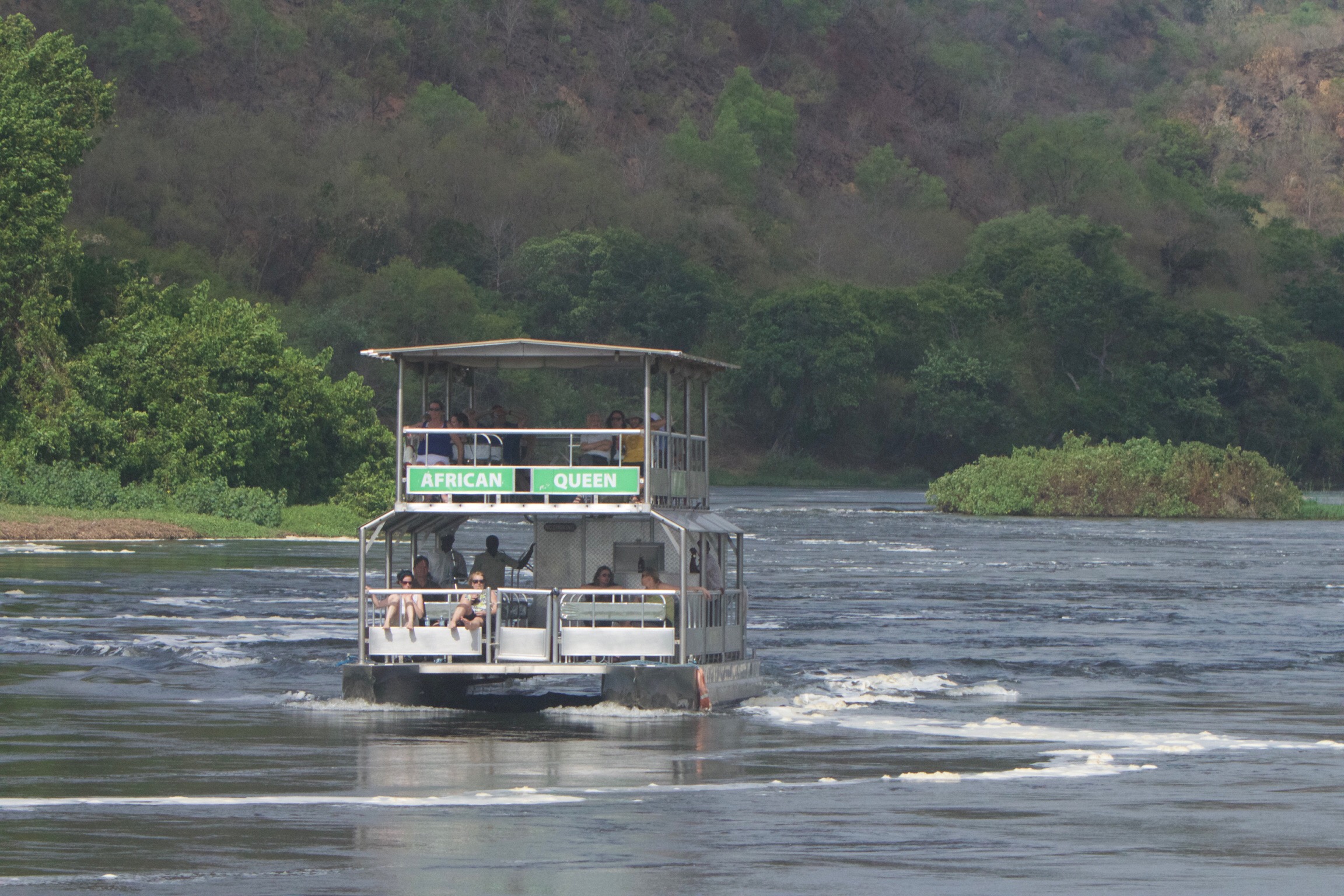
Some of the guests disembarked at a dock near the falls to hike up to the ‘Top of the Falls.’ Since we had planned to do that on Wednesday on our exit from the park, we stayed on the launch and enjoyed the return trip.
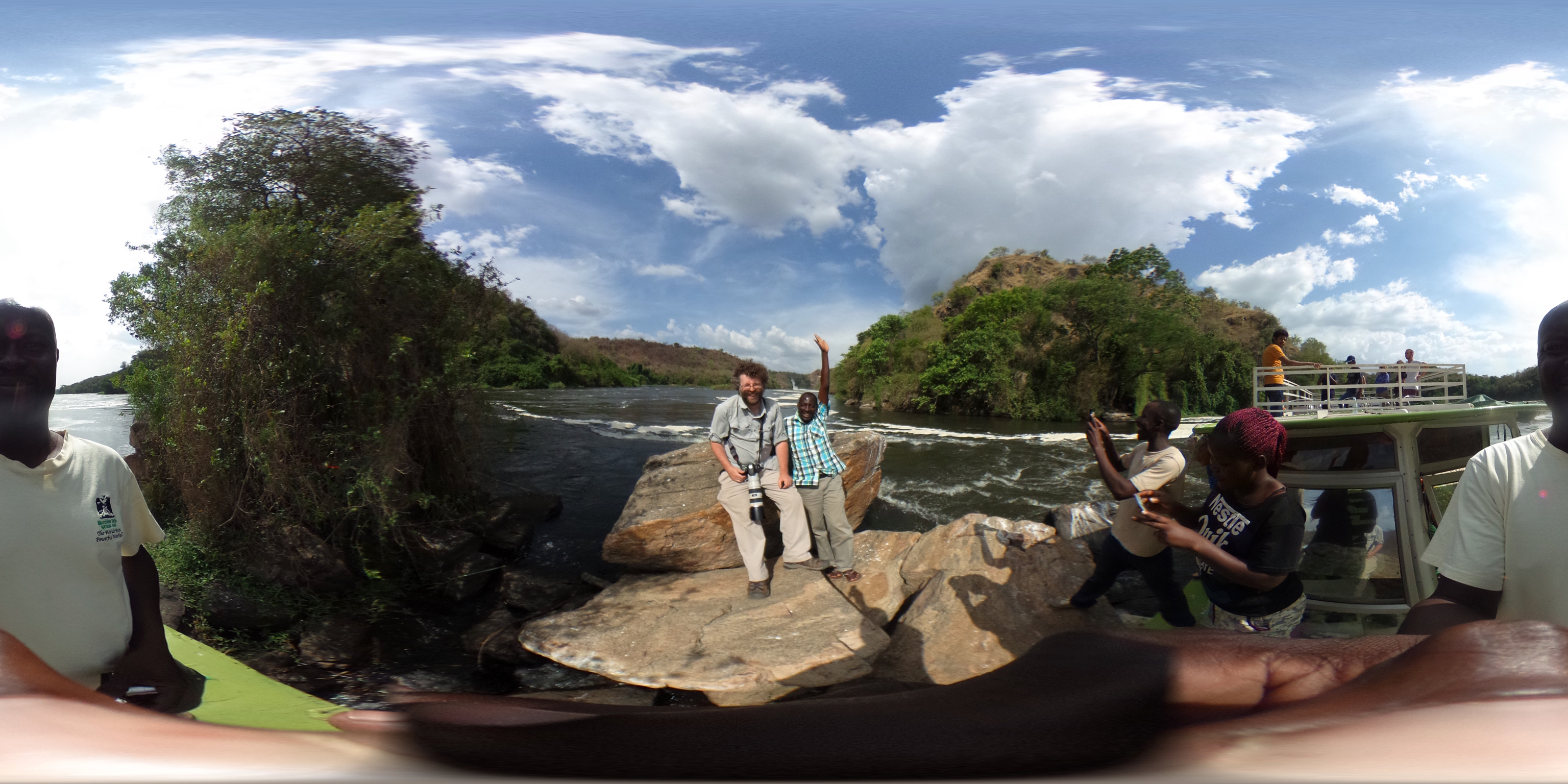
George with our most excellent guide – Brian Twesiime
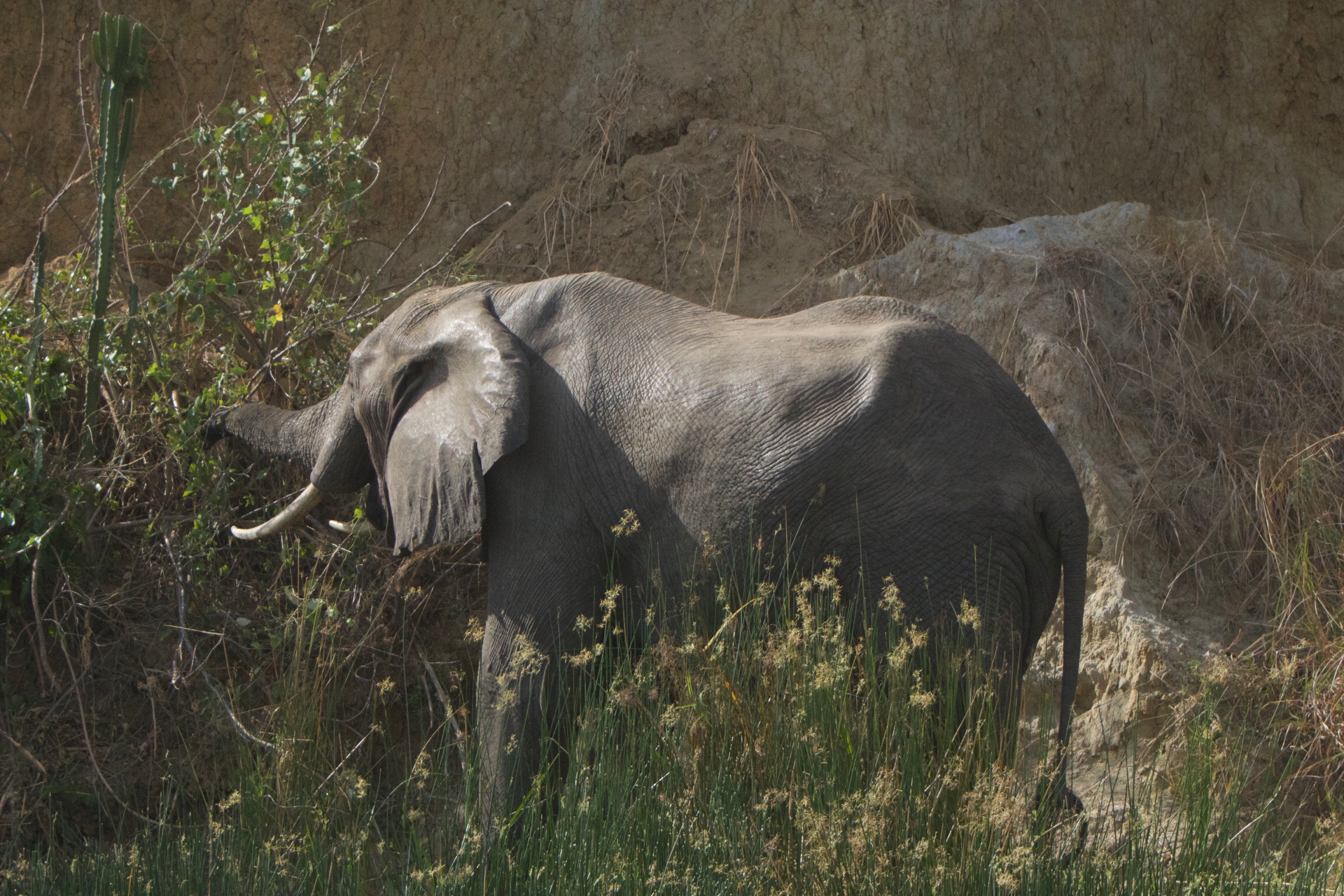
We saw an elephant in what appeared to be a precarious location near the river. Brian thought that he would figure out how to extricate himself. In any case, he was contentedly munching away as we passed.
At the end of our cruise, we got to wait for an hour until the ferry arrived from the other side of the river. I struck up a conversation with the cashier, Harriet, who lived nearby. Her husband lives in Arua with their two children. She was expecting her third. She was interested in Canada, day care, health care, etc. Brian told me that he expected to get a better deal from her on his next visit. I said that I hoped that I had done my part.
We watched kingfishers practicing their dives for fish in the river. It really is amazing to see them hover, then swoop down.
Brian almost ended up with a baboon in his vehicle. While chatting with someone else in the clearing, he had left the driver window of his vehicle open. The baboon likely smelled the remnants of Marion’s bananas. Brian raced back just in time to scare off the intruder. This wasn’t the end of the wildlife excitement for the day, as a family of warthogs walked between the dinner tables and the campfire benches just around dinner time at Red Chilis.
We retired to our cabin to pack up before the generator (and the lights) went off at 10 p.m.
March 22 – We arose early for this our last day, and managed to leave Red Chili around 7 a.m. with our bagged breakfast.
We headed off to the Top of the Falls parking area. Finding no guide on duty at this meeting area, we took off on our own, climbed to a lookout for pictures, and then down to the area just above the falls. Murchison Falls comprises two waterfalls around a central island. We were able to closely approach the tighter waterfall – interestingly, not the one viewed from the launch we were on yesterday. We continued on the circular path back to the parking area and continued on our trip back to Entebbe. Just before leaving the park, we stopped to allow a giant lizard to cross our path.
The return trip to Masindi and Kampala was without incident. We went a little further into Kampala than we needed to in order to rendezvous with Salome who had a DVD for George. We all said quick good-byes as she returned to her school classroom, and we continued on to Entebbe. It struck me that the rendezvous process involving contacts between Brian and Salome would simply not have been possible years ago, but now with the help of mobile phones and texting, is relatively easy.
We had two quick stops before going to the airport. First, I picked up some Uganda Waragi, a Ugandan gin at a supermarket. Second, at George’s suggestion, we had a final meal. Brian picked a lovely locale overlooking Lake Victoria, Faze-3. While we were awaiting the meal, Marion phoned to thank us for coming, and to wish us a safe trip home. I’m not sure our pictures on Brian’s camera will really do justice to the view.
We did a final accounting with Brian, divvied up our remaining Ugandan funds between a tip for him and a contribution to Marion’s school, and bid farewell.
At the airport, we managed to separate a wheel from my piece of luggage just prior to security. Then after security, George met a buddy from Pioneer Camp, David Arnold. David was in Jinja with church friends to visit a couple exploring street ministry possibilities. While he was chatting with David, I met an Indian fellow who now lives in Mississauga. He owns a gas station and grocery store in Lugazi. Business there is so-so, he said. He comes to Uganda twice a year to go over the books with his accountant.
There were computer glitches that slowed down sign-in at Ethiopian Airlines, and a short electrical problem that interrupted boarding, but finally we made it on to the plane. George was surprised with me, but I insisted on sitting in our designated seats. I really wanted to view Entebbe, Lake Victoria and the Nile on this departure from a window seat. It is quite a sight.
On the very full Addis to Toronto segment, I sat beside an Eritrean refugee, Arun, who was going to Whitby. When we got to Pearson, the International Organization for Migration bag he was carrying was the signal that workers at Immigration were looking for. Off he went to his new world. In our turn, we were met by Nancy to return us to ours.
 nancybellblog